
A thrilling burst of handheld speed with an Emerald hunt that fights its own momentum
Sonic Advance 2 pushes speed much harder than the first Advance, and that decision gives it both its greatest appeal and its most obvious frustration. I enjoy how confidently the stages send the characters through springs, rails and fast changes of direction. When a route comes together, the movement is lively enough to make another run immediately attractive. The problem is how often the game asks me to interrupt that momentum to satisfy its optional requirements, or react to a danger that the pace makes less comfortable to read. The result is a good handheld platformer that I like more in ordinary play than in a completion-focused run. Seven and a half is where I land. There is a lot of fun here, and Cream is a worthwhile addition to the cast, but the balance between speed, clarity and collecting is not strong enough to make the whole adventure equally satisfying.
The faster emphasis is not just a change in the background or a different animation. Larger stages, abundant launchers and a movement system that rewards maintaining momentum make the game feel more eager to keep going. Boost Mode grows out of sustained speed rather than a separate meter that can simply be spent whenever convenient, and I like that connection to how a route is being handled. The afterimages make the state clear, while the ability to carry that pace over water gives it a practical use beyond the visual effect. Rings help the character reach that state sooner, so collecting them can support the immediate pleasure of moving. At its best, the game makes those systems reinforce one another. I enjoy learning how to preserve a line and keep the stage flowing, especially when a spring or a rail carries that movement into another section without making the whole thing feel entirely automatic.
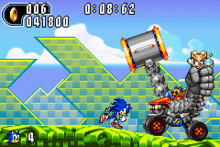
The trick actions add another useful layer to that movement. Coming off a spring or ramp can become a decision about how to adjust the next part of the jump, rather than only a moment to watch the character travel. I like having a small action that can extend the route or change the way an airborne section is approached. It makes the faster design more engaging than a collection of speed pads would be on its own. The limitation is that the game does not always communicate every demand as comfortably as it should. A stage moving quickly toward a hazard needs to give the player a fair chance to understand what is coming. When that clarity is weaker, the same speed that makes the game exciting can make the next interruption feel abrupt. I do not want the whole adventure slowed down. I want the fast parts to be readable enough that maintaining momentum feels like an earned skill rather than a reward for already knowing exactly where the next problem is.
Cream and Cheese are a good addition because they offer more than another familiar movement silhouette. Flight gives Cream a way to recover or approach a higher route, and Cheese's attack makes enemies and bosses a different kind of problem. I like how approachable that combination is without requiring the game to abandon the same stages used by the other characters. Tails and Knuckles still provide useful alternatives through their established abilities, and Sonic remains a satisfying baseline for the faster structure. The unlockable cast creates a reason to keep going, although the demands for reaching every last reward can become excessive. I enjoy a different character when the abilities make a stage feel fresh. I am much less enthusiastic about repeating a demanding collecting routine simply because the completion conditions require it again. The characters are worth having; the game does not always choose the most enjoyable way to ask for the extra effort associated with them.
The seven special rings needed within an act are my largest reservation. The basic idea of searching for hidden access to a bonus stage is reasonable, but requiring the full set in a single run clashes with how strongly the ordinary stages encourage moving forward. I can enjoy looking for a route or an optional object. I find it less enjoyable when missing one item means the whole attempt has failed at its secondary purpose. The Emeralds are also tracked separately for the characters, making the pursuit a much larger commitment than a single successful set of searches. The special stages themselves add another challenge after access has been earned, so there are several demands layered between ordinary stage completion and the fuller reward. I understand why the game wants a substantial optional goal. I do not think the amount of repeated searching is as enjoyable as the movement it interrupts, and that keeps my recommendation more qualified than the strongest stages would suggest.
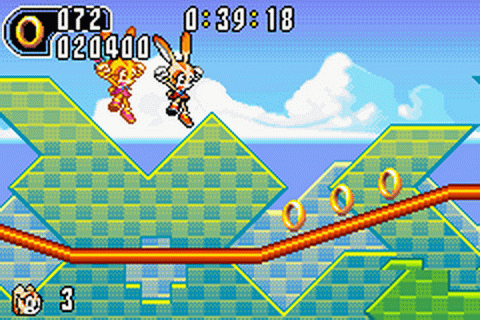
The running boss fights fit the game's obsession with speed, and I appreciate that they try to keep the action moving instead of placing every encounter in a static room. They also narrow the rhythm of the fight. Staying on the move can make recovering from a hit less comfortable, and the cast's different abilities do not all feel equally useful under that demand. I like the spectacle and the idea more consistently than the detailed balance of every encounter. The colorful presentation and music help keep the adventure inviting, while Time Attack gives its best quality a more suitable outlet than the Emerald hunt does. Trying to improve a familiar act makes sense in a game so concerned with momentum. That is where I find the replay structure most appealing: another chance to handle an enjoyable route better, without the whole run depending on locating every special ring first. The game has strong reasons to return, just not equally strong reasons across all of its optional systems.
Advance 2 remains an enjoyable Sonic game despite those reservations. The speed has energy, the tricks give the movement more to do and the cast makes the stages worth approaching in different ways. I like the presentation and the confidence of the faster design. I would simply rather enjoy that design than spend so much of a completion run fighting against it through exhaustive ring searches. Abrupt hazards and uneven boss encounters are additional reasons to keep the praise measured. Seven and a half out of ten fits a game I recommend for its lively core rather than for every requirement around it. The best routes show how entertaining a fast handheld Sonic can be. The weaker collecting structure shows how easily a game can make its own strongest quality less enjoyable by attaching the wrong kind of repeated demand to it.
Final thoughts
Advance 2 has exciting speed, useful trick actions and a cast that gives its routes variety. The seven-ring special-stage requirement is much less enjoyable, and the faster pace can make hazards and bosses awkward. I recommend the lively platforming more strongly than the completion hunt. 7.5/10.
Final score: 7.5/10.
Reviewed on Game Boy Advance. No review copy was provided.
 Sonic Dash 2 Sonic Boom Review
 Sonic Advance 3 Review
 Sonic Advance Review