A lively Boom makeover with extra systems that do not make the repeated runs more satisfying
Sonic Dash 2: Sonic Boom has a clear, energetic first impression. The Boom cast gives the familiar endless-runner structure a different personality, and the team selection adds something beyond changing the character on screen. I like those ideas more than I like the experience of repeatedly pursuing the next target. The ordinary running becomes familiar quickly, while the extra progression does too little to make that familiarity more enjoyable. Four out of ten is my score. I do not think every mobile sequel needs a completely different control scheme, but I want its additions to make the same basic actions feel worth returning to. Here they too often feel like more systems attached to a loop whose limits remain obvious. The game is colorful and easy to understand, with a few useful changes, but the complete package asks for more repeated attention than I find the underlying activity deserves.
The central controls remain straightforward. Swiping between lanes, jumping and sliding give the next obstacle a clear response, and the automatic forward motion keeps an attempt moving without a large setup. I appreciate how suitable that is for a phone. A brief challenge can begin with very little explanation, and a good sequence of reactions can have an enjoyable rhythm. The problem is how quickly the arrangements begin to feel like another example of something already understood. The game needs the route to keep producing interesting combinations because the actions themselves are deliberately limited. I find some small bursts entertaining, but the desire to start another attempt is much weaker than the clarity of the controls might suggest. A simple input scheme is a strength when it opens the way to a compelling activity. It is less valuable when it mainly makes a repetitive activity easy to repeat, which is where too much of my reaction to this sequel ends up.
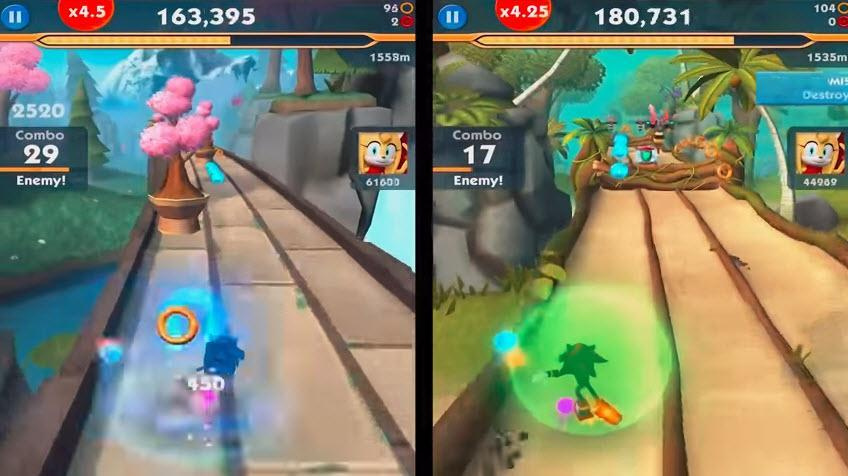
The team system is the most useful addition. Choosing a group of characters and switching at junctions gives the cast a role in the structure of a run rather than limiting it to an unlock screen. I like that the selection can involve a different ability and a practical decision about when to change the approach. Banking rings at those points also gives a junction another purpose beyond changing the appearance of the route. The idea has value, but I do not find it transformative. A new teammate can alter the immediate possibilities without making the next series of lane changes feel fundamentally different. I appreciate the attempt to give the runner more shape and a small planning layer. I simply want the ordinary sections between those decisions to be more consistently interesting. The team feature gives the game a reason to be distinct, while the repeated action still decides whether that distinction is enough to keep the whole attempt enjoyable.
The Enerbeam sections provide another change of activity, with tilting used to steer the character while moving along the beam. I like the intention to break up the usual sequence of swipes and jumps. A mobile game can benefit from a small variation that is easy to understand without requiring a separate tutorial every time it appears. My reservation is that changing the input is not automatically the same as adding an enjoyable decision. The beam is a recognizable Boom feature, and it helps the package look different, but it does not make me much more enthusiastic about repeating the complete run. The same pattern appears across the game: an addition has a sensible purpose on paper, then contributes less to the actual enjoyment than I want. I do not need every section to be complicated. I need the variations to feel rewarding enough that another run promises more than a familiar routine with a slightly different interruption along the way.
The character abilities and helpers give progression several directions. A different runner or Sprite can change how an attempt is supported, and I like that the rewards have a more recognizable identity than a generic improvement counter. The cast's different attacks and effects also make the action visually lively. The difficulty is how much of the wider experience becomes organized around obtaining or developing the next useful option. I am less interested in maintaining that progression than I am in a run that is enjoyable on its own. When the next reward becomes the strongest reason to repeat the route, the game starts to feel more like a routine than a challenge I actually want to attempt. The additional systems make the package busier without giving the central actions enough extra appeal. I can appreciate what an improvement does while still wishing the process of pursuing it offered more interesting situations instead of asking for another series of familiar ones.
The presentation is easy to like in isolation. The Boom characters are expressive, the scenery is bright and the movement has enough energy to make a quick attempt look inviting. I enjoy the idea of giving the cast a mobile game that uses its particular appearance and team identity. That appeal is strongest before the repetition becomes prominent. The colorful effects and familiar faces can make another obstacle sequence more pleasant to watch, but they cannot make every repeated objective feel worthwhile. I find myself appreciating the surface more consistently than the demand underneath it. This is not a case where the game has no personality. It has plenty, and the problem is that the personality does too much of the work of making the routine appealing. I want the presentation to amplify enjoyable play rather than keep trying to renew interest in an activity whose small range of decisions has already become too familiar for me.
I finish with a disappointed opinion. The team selection is a useful idea, the Enerbeam provides a distinct variation and the Boom presentation gives the game an inviting face. The repeated runs and progression still do not stay interesting enough to support the amount of attention they ask for. Four out of ten reflects that imbalance. I can enjoy a short stretch without seeing a good reason to commit to the wider cycle, and a mobile game designed around that cycle needs a stronger answer. I am not asking for the endless-runner format to disappear. I am asking for its additions to make the ordinary route more rewarding rather than merely supplying another target outside it. Dash 2 gives me more things to consider and more characters to look at, but too little additional pleasure in the repeated act of moving between lanes, reacting to hazards and beginning the same basic process again.
Final thoughts
The Boom cast, team switching and Enerbeam sections give Dash 2 some useful distinctions. They do not make the repeated running or progression compelling enough for me. I enjoy the lively appearance more than the ongoing routine, leaving the whole package disappointing at 4/10.
Final score: 4/10.
Reviewed on iOS using iPhone 13 Pro Max. No review copy was provided.
 Sonic Boom Fire & Ice Review
 Sonic Boom Shattered Crystal Review
 Sonic Boom Rise of Lyric Review