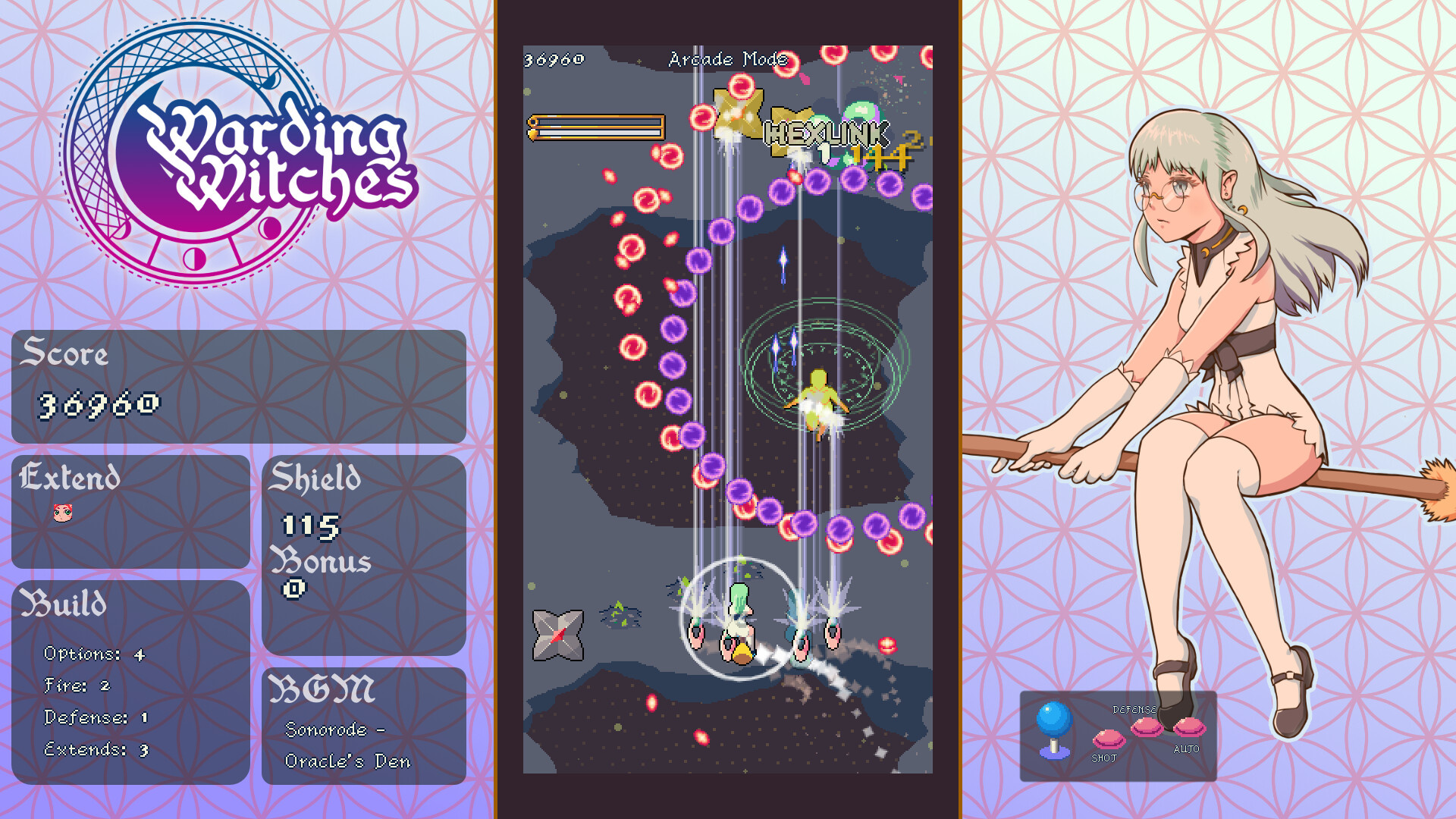
Warding Witches has a strong answer to a familiar bullet-hell problem: what should happen when the screen becomes overwhelming? Its defensive abilities offer a way to respond without making positioning irrelevant. They are tools to understand and incorporate into a pattern, which gives the shooting a satisfying relationship between aggression, protection, and movement.
The distinction matters because defense can easily become a separate emergency action. A screen-clearing solution briefly removes the immediate problem, then returns you to the normal flow. Warding Witches makes its defensive systems part of that flow. Deciding when to protect yourself affects what you can safely attempt and how you continue through the remaining danger.
The different witches give this idea useful variation. Their shot types, movement, and defensive workings create distinct approaches to the same general challenge. Changing character is therefore more meaningful than choosing a different visual design. It changes the tools available for managing space, and encourages a different balance between remaining safe and taking an opportunity.
Scoring reinforces that balance. The game connects effective use of its systems with bonuses and improvements, giving a good reason to learn beyond basic survival. I like that the scoring is not merely a number displayed after the interesting part is over. It gives the action another purpose while it is happening. Better understanding can improve both the result and the way a run develops.

This is still a demanding shooter. Defensive options do not remove the need to recognize patterns or control movement carefully. That distinction is worth making for anyone attracted by the colorful artwork. There is a substantial challenge behind the presentation, and the easier settings should be understood as an entry into that challenge rather than a guarantee of effortless progress.
Story mode provides a more forgiving structure for learning, while arcade play puts greater emphasis on maintaining a complete run. That separation makes sense. It creates room to understand stages and systems before trying to apply that knowledge under stricter conditions. The game can welcome an interested newcomer without abandoning the repetition and practice that give this genre much of its depth.
The audiovisual presentation is another major strength. The pixel art gives the witches and enemies a clear identity, and the soundtrack has enough energy to support the intensity of the action. Music is particularly important in a game built around concentrated, repeatable sequences. Here, it helps the stages retain their appeal when the goal shifts from reaching the end to playing more effectively.
The limitations are mostly about scope and expectations. Repeating stages is central to the design, and someone looking primarily for a constantly changing campaign may find that structure restrictive. The story is a secondary attraction. Neither point ruins the experience, but both make Warding Witches a more specific recommendation than its approachable appearance might suggest.
What makes it work is the coherence of its main systems. Shooting, defending, moving, and scoring support the same goal: developing a more deliberate response to a difficult pattern. Warding Witches does not need an elaborate surrounding structure to make that process engaging. It is a strong, distinctive shooter with enough character and mechanical purpose to make learning it worthwhile.
Final score: 8.5/10.
Reviewed on PC (Windows/Steam) using a supplied review key.
Game information: https://store.steampowered.com/app/3536520/
 Onimusha: Way of the Sword - Review
 Disney Speedstorm Review
 Zap Blastum Review