
A worthwhile handheld adventure whose small view makes careful play essential
The Game Gear version of Sonic the Hedgehog has more appeal to me when I approach it as its own small adventure. It belongs to the 8-bit design rather than being a miniature copy of the Genesis game, and that distinction is important to how it plays. Running, jumping and collecting rings are familiar, but the stages put more emphasis on deliberate platforming and looking around. I like that the game has a recognizable sense of purpose instead of only trying to reproduce the larger version's most obvious visual features. There is a good adventure here, with clear environments and a worthwhile reason to explore. My reservations come from how the handheld view changes the relationship with those environments. A limited amount of visible space makes care and familiarity more important, and that can work against the pleasure of simply moving forward. I enjoy the underlying design more consistently than I enjoy the restrictions surrounding it.
The immediate actions are straightforward, and I appreciate how much the game can ask of them without introducing a complicated set of abilities. A jump needs a useful landing place, rolling has a purpose, and the route matters more than maintaining the highest possible speed at every opportunity. I like having to judge the space in front of Sonic rather than treating the level as something that will look after the movement automatically. The slower rhythm can give a small stage more personality, because the details remain relevant for longer. At its best, that makes a careful sequence of platforms satisfying in a way that is different from a long, fast stretch in the Genesis game. I do not think being a more measured Sonic adventure is itself a weakness. My problem is that measured play is most enjoyable when the space gives me enough information to make the next movement feel considered rather than uncertain.
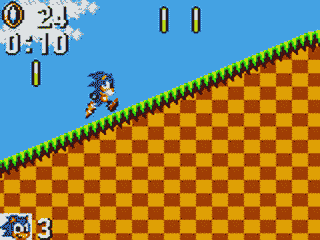
That is where the Game Gear's visible playfield becomes my main reservation. Compared with the Master System presentation of this 8-bit design, less of the surrounding level is available to read at once. I find that important in a game where landing, hazards and the shape of the next platform are such a large part of the interaction. The smaller view makes a cautious approach more attractive, even when the character and the terrain suggest moving more freely. Familiarity can help with that, but knowing a route and being able to read it clearly in the moment are different pleasures. I prefer the latter to do more of the work on an initial approach. The handheld version remains perfectly understandable as a platformer; I am not suggesting its controls stop functioning because of the screen. I simply find the narrower window a meaningful limitation on a design that benefits from paying attention to what lies ahead.
The zones give the journey a better identity than a generic description of small-screen Sonic might suggest. Green hills, bridges, jungle scenery and more enclosed spaces provide different kinds of surroundings for the basic controls. I enjoy that the adventure has its own sequence and rhythm instead of relying entirely on the memory of Genesis stages. A change of setting matters when it also changes the way I read a route or approach a platform. The more deliberate pace gives those differences room to register. I do not need every environment to introduce a large new system, especially in a game built around a small set of actions. I want each place to give those actions an interesting arrangement. The game does that well enough to keep me involved, even if some stretches are more enjoyable to look at than to negotiate through the restricted view. Its personality is a strong part of why I remain positive overall.
The Chaos Emeralds give looking around a larger purpose. They are hidden within the normal stages rather than being the reward at the end of the bonus areas, so a route can contain something worth finding beyond the exit. I like that connection between exploration and the main adventure. It makes the landscape part of the optional goal instead of moving all of the extra material into an unrelated sequence. The search also fits the slower style of platforming. Paying attention to an area can be useful for both getting through it and understanding where a collectible might be hidden. I do not need the game to turn every secret into an elaborate puzzle. A small discovery can be enough when the environment makes it feel worth looking. The handheld view complicates that enjoyment for me, but it does not remove the appeal of having something meaningful to search for alongside the normal progress through the zones.
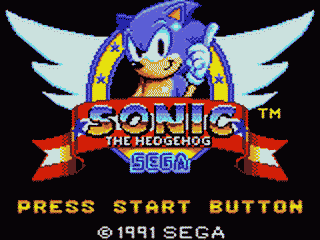
Rings and Robotnik encounters give the danger a clear structure. During ordinary platforming, carrying rings offers protection against many hits, while the boss acts remove that comfortable safety net. I like that the same basic movement can be asked to do different work under those conditions. A normal route can involve finding a useful line through the scenery; an encounter with Robotnik places more weight on watching an attack and choosing a safe opening. That is a sensible way to create contrast without replacing the controls. I enjoy the simplicity of the presentation around those actions as well. The colorful sprites and compact environments make this feel like a purposeful handheld game, not a collection of empty placeholders for a larger version. The sound and visual identity help the stages feel lively. I would just prefer a wider opportunity to read the action before committing to some of the movements the levels ask for.
My final reaction is positive, with a reservation that remains present throughout. I enjoy the original 8-bit structure, the more deliberate platforming and the way the Emerald hunt gives the normal stages another layer of interest. Those are real strengths, and I do not think the game needs to imitate Genesis Sonic more closely to justify itself. The smaller visible area is the part I find hardest to ignore. It encourages a kind of caution that does not always sit comfortably with the freedom of the movement, and it makes familiarity carry more of the experience than I would like. That keeps the handheld version from becoming one of my strongest Sonic recommendations. It is still a worthwhile adventure with enough of its own personality to be enjoyable. For me, a seven reflects a game whose core ideas work, while the window through which I have to experience them remains a meaningful compromise.
Final thoughts
I like the Game Gear Sonic for its distinct 8-bit adventure, careful platforming and meaningful Emerald search. The restricted view makes some of that design harder to enjoy freely, placing too much emphasis on caution and familiarity for my taste. It remains a good handheld game with its own identity, and a qualified 7/10 rather than a substitute for the Genesis original.
Final score: 7/10.
Reviewed on Sega Game Gear. No review copy was provided.
 The Murder of Sonic the Hedgehog Review
 Sonic the Hedgehog Spinball [8-bit] Review
 Sonic the Hedgehog Spinball 16-bit Review