
The pinball adventure loses too much of its appeal in this cramped handheld form
The 8-bit Sonic Spinball keeps an idea I still find appealing: Sonic's ball form can be the center of a pinball adventure rather than only a short sequence inside an ordinary platformer. The Game Gear version gives that concept a portable form, with flippers, targets and Emerald objectives shaping the progress through its environments. I can appreciate the attempt, but I find the result disappointing. The regular interaction does not give me enough pleasure to make the adventure structure feel worthwhile. A good objective can make a table interesting to understand; it still needs the movement toward that objective to be enjoyable. For me, this version struggles with that second part. The compact presentation and the awkward relationship between a planned shot and its result make the play feel less inviting than the premise. It is recognizable as Spinball, but recognition is doing more work than the fun for much of the experience.
The flippers make the basic interaction easy to understand. Timing a hit is supposed to send Sonic toward a useful part of the environment, connecting a small action to the next stage of the table's progress. I like that relationship when it feels clear. A pinball game can make a simple input satisfying by giving the result enough shape and purpose. Here, I find the repeated work of arranging a useful movement more noticeable than the satisfaction of completing it. The action can keep me occupied without making me especially interested in the next attempt. That is a major reservation in a game built around repeating and improving a shot. I want another bounce to feel like another opportunity, rather than another interruption before returning to the place I already know matters. The controls have a purpose, but I do not find the interaction they produce rewarding enough to carry the game.
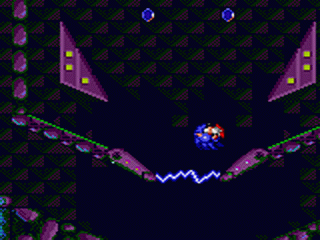
The Emerald objectives give the main stages a larger structure than a conventional high-score table. Sonic has to work through the layout, collect what is required and open the way toward completing the area. I appreciate that the game is trying to give the pinball a sense of journey. Targets and routes become parts of understanding a place, not simply things that add points when touched. My disappointment is that understanding the requirement can be more satisfying than working toward it. Once the goal is clear, the remaining attempts to send the ball through the useful route can feel drawn out. That is where the adventure idea starts to pull against the immediate play for me. A table with an objective needs both an interesting problem and enjoyable actions through which to solve it. This version has some appeal in the problem, while giving me much less pleasure in the repeated actions needed to finish it.
The Game Gear view also asks a great deal of a small space. A pinball adventure needs the player to understand where the ball is, what lies around it and which direction would be useful next. I find those relationships less comfortable to read here than I would like. The more attention I have to give to interpreting the current space, the harder it is to enjoy the movement as a flowing activity. Familiarity can help, but I want the visual presentation to do enough work on its own too. The hardware's scale is part of the format, a disappointment with the way the ball moves between its targets. My criticism is about the experience of reading and responding to the table. The small view makes an already demanding relationship between timing and position feel more restrictive, and that restriction regularly weakens the appeal of the objective-driven structure.
Sonic remains a sensible character for the concept. Curling into a ball, reacting to springs and being sent through curved routes all fit an identity already present in the main games. I like that the spin-off has a concrete connection to what the character does rather than relying entirely on a familiar face pasted onto another genre. The difficulty is that recognizing the connection also makes me want a kind of freedom the pinball design is not meant to provide. An ordinary Sonic stage invites direct movement through a route; Spinball asks for a different relationship with the ball and the table. That difference can be enjoyable, but this version does not make it enjoyable enough for me. I am left thinking more about where I want Sonic to go than appreciating the process of sending him there. The idea fits the character much better than the regular play fits my preferences.
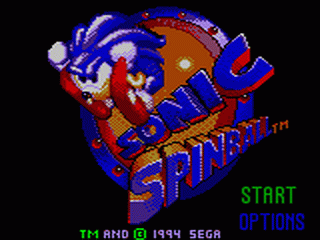
The mechanical settings give the adventure a recognizable atmosphere. I appreciate that the table is presented as an environment full of channels, hazards and machinery rather than a completely abstract set of bumpers. That identity is important to what makes Spinball different from an ordinary pinball simulation. It creates a reason to be curious about the next part of the layout. The problem is that visual curiosity does not consistently become enjoyment of the movement. I can like the way a place is conceived while still disliking the time spent trying to negotiate it. The portable presentation communicates the basic identity, but it does not make the interaction feel especially comfortable or satisfying. For me, the strongest part of the package is knowing what kind of adventure it is trying to build. The weakest part is how little pleasure I get from carrying out the pinball actions that are supposed to bring that adventure to life.
I do not come away from this Spinball thinking the overall idea was a mistake. The connection between Sonic and pinball is clear, and the larger objectives give the stages something more interesting to do than only count points. My low recommendation is about this particular handheld realization. The compact view, repeated attempts at useful routes and uneven satisfaction of the flipper interaction make the game less enjoyable than its structure suggests. There is enough curiosity value to understand why someone interested in Sonic's portable history might want to look at it. I would be much less confident recommending it as a pinball game to spend time with for pleasure. A four and a half reflects that disappointing balance. The version preserves the recognizable concept, but it gives me too little enjoyment in the actual movement to make that concept feel like a worthwhile adventure on the Game Gear.
Final thoughts
I can appreciate the idea of a portable Spinball adventure, with Emerald objectives giving the tables a purpose beyond scoring. The cramped view and unsatisfying work of arranging useful shots make the Game Gear version difficult to enjoy consistently. Its identity is more appealing than its interaction. For me, it is a disappointing 4.5/10 rather than a compelling handheld pinball game.
Final score: 4.5/10.
Reviewed on Sega Game Gear. No review copy was provided.
 Sonic the Hedgehog Spinball 16-bit Review
 The Murder of Sonic the Hedgehog Review
 Sonic the Hedgehog 2 16-bit Review