
A brilliant foundation whose slower stretches still interrupt the rush
Sonic the Hedgehog gets something right that still matters to me: moving a character can be enjoyable before a game has explained very much at all. Sonic runs, jumps and curls into a ball, but slopes and momentum make those familiar actions feel different from simply holding a direction. I like having to understand the shape of the ground rather than treating speed as a constant setting. A downward roll can create an opportunity, while an uphill stretch asks whether I carried enough momentum into it. That relationship gives the Genesis original an identity beyond its colorful mascot. It is an excellent platformer with a very clear attraction, and I enjoy how quickly that attraction becomes understandable. My reservations come from the way the adventure sometimes interrupts its own strongest rhythm. The game can be wonderfully fluid, then surprisingly cautious. Both sides have worthwhile ideas, but I do not find the connection between them equally convincing throughout.
Green Hill is such a good introduction because it demonstrates that movement through the layout itself. Slopes, springs, platforms and loops give Sonic space to accelerate without making every route a straight corridor. I enjoy how the scenery helps explain the possibilities. A curve suggests momentum, a platform suggests another route, and a spring turns a small space into a much larger movement. The zone gives me room to enjoy the character while still asking for attention to enemies and gaps. I do not think speed alone is what makes it work. The important thing is being able to connect actions into a route that feels satisfying. That is why a familiar stretch can remain enjoyable without a new reward being added at every turn. Understanding where to jump and when to roll is already a reason to return. Green Hill sells an idea of Sonic that is immediately appealing to me, and it remains one of the game's strongest expressions of that idea.
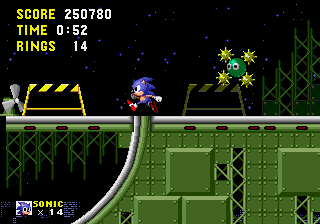
Marble Zone changes the relationship with the environment considerably. Lava, moving blocks and more deliberate platforming make patience useful in a way that the opening zone does not emphasize. I respect the intention to test something beyond forward momentum, and there are sections where judging a small movement has its own satisfaction. My problem is the interruption to the larger rhythm. After a level that makes running feel so inviting, stopping to wait for hazards or carefully follow a slower sequence can feel like the adventure is pulling against its main appeal. I do not need every stage to reproduce Green Hill. Variety is important, and pure speed without contrast would become tiring too. I just prefer the changes that preserve a connection to Sonic's movement instead of making caution feel like the dominant activity. Marble is a useful example of why I love this game without considering every part of it equally successful.
The ring system is another excellent piece of the foundation. Carrying rings protects Sonic from most ordinary hits, while losing them creates an immediate problem that is easy to understand. I like the way scattered rings turn damage into a short decision instead of always ending the action outright. Recovering protection can matter more than trying to preserve a perfect-looking run. At the same time, rings do not remove the danger of pits, crushing or running out of air underwater, so the system is not a universal excuse to ignore the environment. That balance gives the controls room to be playful while keeping the hazards relevant. It also makes collecting rings feel connected to survival rather than functioning only as decoration along the route. For me, the strongest parts of Sonic's design are those where one simple rule affects several different situations. Rings do that very well, and their clarity helps the game remain approachable without making it empty.
The special stages give the exploration of that rule a different setting. Reaching the end of an appropriate act with enough rings provides access to a rotating maze where the goal is to reach a Chaos Emerald while navigating the layout. I enjoy how different that feels from the normal stages without requiring an unrelated collection of controls. Sonic's movement is still the central concern, but the rotating space changes how I judge it. The stages can be awkward, and I do not find every bounce as satisfying as a good stretch of normal platforming. Even so, they give the game a worthwhile optional objective. Collecting the six Emeralds adds a reason to care about more than simply seeing the next zone. I appreciate that the main adventure remains playable without turning those challenges into a constant barrier. They broaden the game without replacing the straightforward pleasure of working through its stages.
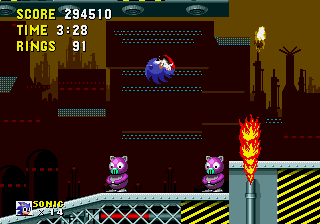
The presentation brings all of this together with a confidence I still enjoy. Sonic is expressive, the scenery has a strong sense of place, and the music gives each zone a recognizable mood. I love how the game can establish an environment quickly through its colors, shapes and sound. Green Hill does not feel interchangeable with the industrial spaces later in the adventure, and the underwater setting changes the atmosphere as well as the movement. Robotnik's machines give the zone endings another clear visual identity. The encounters generally work through readable patterns rather than a complicated combat system, which suits a character whose jump is already an attack. I prefer that focused approach to introducing a separate set of fighting controls just for the bosses. The audiovisual personality helps the simple actions feel part of a complete adventure, and it gives the game a charm that is stronger than nostalgia alone.
What keeps the original Sonic so appealing to me is the strength of the ideas that are already here. Momentum gives running a texture, rings make damage interesting, and the stages invite improvement through familiarity with the terrain. I do not need later features, such as the Spin Dash, to understand why this first version is enjoyable. It has enough of its own character to stand as a strong game rather than only a historical starting point. The slower stretches and some of the special-stage awkwardness remain meaningful reservations, because they affect the part I care about most: the flow of playing. They do not outweigh the excellent controls, presentation and sense of movement. This is a game I can recommend enthusiastically while still wanting a smoother rhythm across the whole journey. The foundation is remarkable, and the best stages make a convincing case for why Sonic became far more than an attractive character on a box.
Final thoughts
I still love the Genesis original for making speed something to understand through the terrain. Its rings, movement and presentation form a terrific foundation, and Green Hill remains an excellent demonstration of what makes it enjoyable. Slower stretches and awkward special-stage moments keep the whole adventure from being equally strong, but the best of it is more than enough for a confident 8.5/10.
Final score: 8.5/10.
Reviewed on Sega Genesis. No review copy was provided.
 The Murder of Sonic the Hedgehog Review
 Sonic the Hedgehog Spinball [8-bit] Review
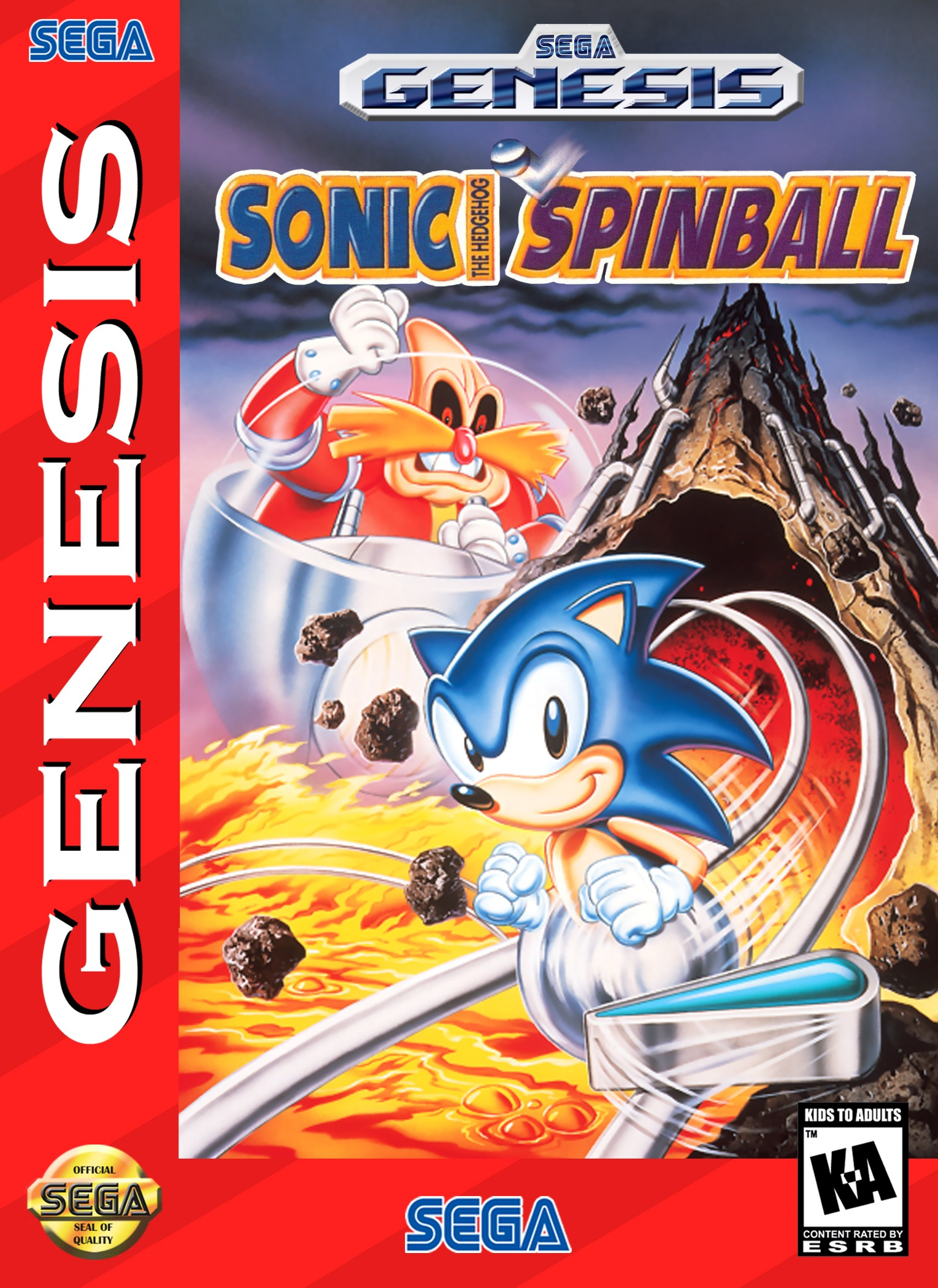 Sonic the Hedgehog Spinball 16-bit Review