
An odd, entertaining board game with enough ideas to make its slow turns worthwhile
Sonic Shuffle is much more enjoyable to me when I accept that its appeal is going to come from awkward plans and changing fortunes rather than constant action. Moving around a board with Sonic characters sounds like a straightforward party-game detour, but the cards give it a distinct personality. I like being able to think about a move instead of waiting for a single random roll to decide everything, and the different spaces, battles and character abilities give those decisions some useful complications. The game is still slow in places, and its interruptions can make the distance between good moments feel longer than it should. That does not erase the fun I find in the structure. I enjoy its strange dreamlike setting and the way an apparently simple turn can become a decision about movement, resources and interference. Seven and a half feels right. It is an entertaining, imperfect spinoff that gives Sonic a different kind of game with enough substance to make the change worthwhile.
The card system is the main reason I find the board play interesting. A hand of numbered cards gives movement a little more intent than a single dice result would, and the ability to take a card from another player complicates that control. The VMU can keep a hand private, making information part of the design rather than something everyone has to see on the television. I like how a move can involve choosing a number for a particular destination while also thinking about what will remain afterward. A useful card has more than one possible purpose, especially when battles enter the picture. That creates a modest but worthwhile planning layer underneath the party-game chaos. It does not remove luck, and I would not want it to. The uncertainty is part of the appeal. What I enjoy is having something to decide before that uncertainty changes the situation, rather than feeling that every turn consists only of watching an outcome I had no reason to consider.
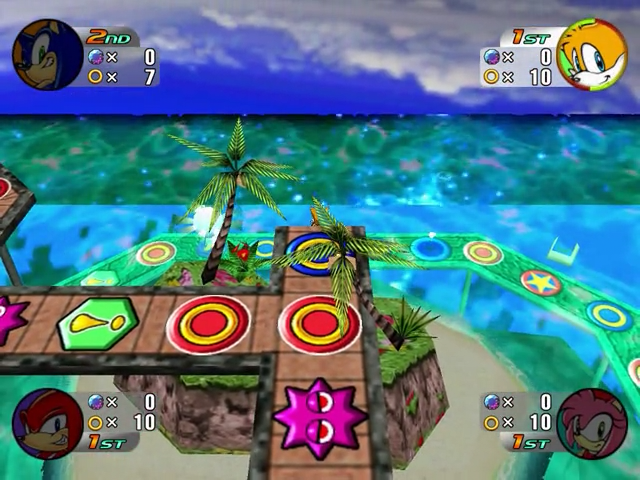
The Precioustones provide a clear focus for the board, but reaching one is not simply the end of the task. A battle stands between the character and the prize, connecting the cards used for movement to another kind of decision. I like that a high-value card can be attractive for travel and for a fight, because keeping it or spending it becomes more interesting than always using the biggest number available. Forcejewels add another layer of disruption and assistance, giving the board more ways to change than ordinary movement alone. The resulting system can produce entertaining changes of fortune. It can also become busy enough that the next clear opportunity takes a while to arrive. My patience is tested more by the pace than by the fact that a plan can go wrong. A party board game needs unexpected outcomes. I just want the turns between those outcomes to stay brisk enough that the uncertainty feels lively rather than drawn out.
The minigames help break up the board play, and their changing team arrangements give the package another source of variety. A free-for-all does not have the same immediate goal as a two-against-two challenge or a situation with one player against three, so the action can shift its emphasis without needing a completely different set of characters. I like those interruptions when they arrive as an enjoyable change of rhythm. Not every small challenge has the same appeal, and some are more entertaining as a brief surprise than as something I would choose repeatedly on its own. The mini-events create a similar mixture. They can add personality and another unpredictable decision, but they can also delay the part of the board I am most interested in. That unevenness is why my score is positive rather than exceptional. I enjoy a good amount of what Shuffle offers, yet I am regularly aware of how much smoother the whole game could feel with more consistent pacing and stronger individual diversions.
The characters and the presentation make a real difference to my enjoyment. Different abilities give the cast a function beyond using familiar faces as board pieces, while the dream setting gives the game room to be visually strange. I like that it has a distinct atmosphere rather than borrowing a completely ordinary collection of party-game spaces and putting Sonic beside them. The Sonic Room also gives progress a place to accumulate, with unlockable pictures and other additions making it feel more personal than a plain completion menu. Those extras are welcome, although they do not solve the frustrations of the main boards. Story Mode requires a winning result to advance, so a long board can become an expensive commitment when the outcome goes badly. I find the competitive structure more appealing than that demand for repeated success across the story. The game has a lot of personality, but it sometimes asks more patience than its individual turns deserve, especially when progress depends on winning the whole board.
I still come away liking Sonic Shuffle. The numbered cards, the battles and the changing routes give me enough to consider that I do not see it as an empty attempt to copy a party-game formula. I enjoy the cast in this setting, and the mixture of planning and disruption makes the board capable of producing worthwhile surprises. My reservations are substantial: the pace is uneven, the minigames vary in quality and a full board can feel like a larger commitment than I want. Those weaknesses keep it from being an easy recommendation for every mood. They do not make the good parts disappear. Seven and a half out of ten reflects a game I find genuinely entertaining with clear limits on how eagerly I want to keep going. Its oddness is part of its charm, and the card structure gives that charm something practical to rest on. I would rather have this imperfect attempt at a distinctive Sonic board game than a safer version with no interesting decisions underneath its familiar characters.
Final thoughts
Shuffle's cards make movement and battles more interesting than a simple roll-and-wait structure, and the dreamlike presentation gives it a character of its own. Slow pacing, uneven minigames and demanding Story Mode progress hold it back. I still find plenty to enjoy in this unusual Sonic spinoff. 7.5/10.
Final score: 7.5/10.
Reviewed on Sega Dreamcast. No review copy was provided.
 Sonic Dash 2 Sonic Boom Review
 SONIC PICO PARK Review
 Sonic Rumble Review