
Walking around a virtual school adds too much work to activities I already find unexciting
Sonic's Schoolhouse takes an unusual route into educational software by putting its activities inside a first-person school. Sonic acts as a guide, while the player chooses an animal character and moves around looking for the answers needed by the exercises. I can understand the attraction of making a lesson into a place to explore. It gives the program a more immediate identity than a plain collection of questions on a screen. My problem is that the extra movement does not make the educational tasks especially enjoyable. It often feels like another layer of work between understanding the question and carrying out the answer. The familiar character and three-dimensional setting provide curiosity value, but the basic activity remains unexciting for me. A four and a half reflects a program with a recognizable intention and some sensible ways to connect its tasks, yet too little pleasure in the process of using them to make the whole experience worthwhile.
The first-person view is the most obvious difference from a conventional Sonic game. This is not a platforming adventure with a school background, and Sonic himself is not the playable character. The animal avatar moves through a space built largely from flat corridors and right-angled arrangements, making the school the practical setting for finding what the exercises require. I like the idea that an answer can be represented by something in the environment rather than only a line of text. The difficulty is whether moving toward that object adds anything enjoyable to the task. For me, it adds more activity without enough interest. I am aware of navigating the school as a requirement, while finding little satisfaction in the navigation itself. The presentation makes the package unusual, but the unusual format is not enough to make the classroom activities feel more rewarding. The world needs to be enjoyable to move through as well as easy to describe.
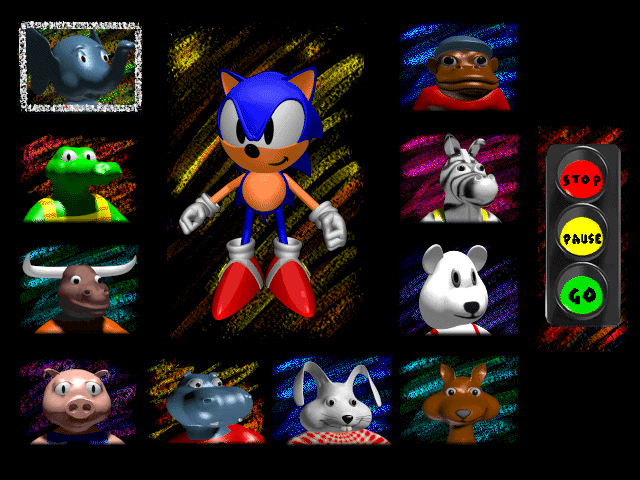
The answer-collecting structure gives the environment its purpose. Letters, numbers and picture objects can be gathered and brought into the interaction with a blackboard to complete the relevant exercise. I appreciate how that makes the subject of a question visible. A word or number is something the player has to recognize, locate and use, which is a clear attempt to connect learning with an action in the world. My disappointment is that the sequence feels more elaborate than the enjoyment it provides. Once the required relationship is understood, finding and carrying out the answer can become the most noticeable part of the process. I want the extra interaction to make the task more playful, not simply longer. Schoolhouse does not do that convincingly enough for me. The structure is understandable, but I find the route between the question and its answer less satisfying than the program's adventurous presentation suggests.
Reading and mathematics give the school a clear educational focus. The picture-and-word matching presents one kind of recognition, while the number-based tasks ask for another. I like that the program is trying to make the activities part of a recognizable setting rather than treating every subject as an unrelated screen. That does not make me especially enthusiastic about the actual exercises. Their simplicity is not automatically a flaw in software aimed at children, and I am not judging them by whether they challenge an adult with advanced material. My criticism is about how enjoyable their presentation feels. The first-person movement and the collection mechanic have to contribute something useful to the activity, because otherwise they become obstacles around a straightforward question. For my tastes, that balance is weak. The school provides a theme for the learning, but it does too little to make the repeated act of answering feel like worthwhile play.
Eggman and the robots add interference to that structure by trying to take the answers or affect the ring activity. I can see why an antagonist might be used to make the virtual school feel more connected to Sonic's world. It gives the environment another recognizable element and introduces a problem beyond simply locating the correct object. For me, though, the added interruption does not improve the task's appeal. The question and the navigation already feel separated by more work than I enjoy. Another obstacle can make the activity busier without making it more interesting. I would rather the connection between learning and movement be satisfying enough on its own than rely on interference to create urgency. The familiar villain supplies a clear visual identity, but that identity cannot make the underlying routine enjoyable for me. The result is a program that looks more eventful than the actual process feels rewarding.
The unlockable minigames and field-trip material broaden the package beyond the classroom questions. Collecting rings and matching statues provide different activities, while the animal facts give the setting another educational direction. I appreciate that there is more than one kind of content to work toward. The choices fit the idea of a virtual school with additional things to discover. My reservation is that the rewards remain more appealing as another part of the collection than as a reason to enjoy the tasks leading to them. A useful reward should add to an activity that already feels worthwhile; it does less for me when the main process is uninteresting. The character presentation has a similar limitation. Sonic's recognizable presence makes the software easy to notice, while doing much less to make the exercise and navigation feel like a comfortable whole. The package offers variety, but the variety never becomes a strong source of enjoyment for me.
I finish Schoolhouse more interested in the unusual use of Sonic than pleased with the program itself. The first-person school, visible answers and additional activities form a coherent educational concept. I understand what the software is trying to connect. The problem is how little enjoyment comes from that connection in practice. Moving through the school and arranging the answer feel like extra requirements around the lesson rather than a playful way to experience it. The familiar cast and unlockable material supply some charm without fixing that central reservation. My four and a half is therefore a judgment of the actual learning-game format, not a complaint that the software should have become a normal Sonic platformer. It tries a different kind of interaction, but I find the interaction too unexciting and cumbersome to recommend positively. The concept is more interesting than the repeated process of taking part in it.
Final thoughts
I can appreciate the idea of making educational questions part of a first-person school, but the navigation and answer collecting add too much work without enough enjoyment. Sonic's presence, the minigames and the field-trip facts provide some charm. They do not make the main routine satisfying. For me, Schoolhouse is an unusual but disappointing educational game at 4.5/10.
Final score: 4.5/10.
Reviewed on PC. No review copy was provided.
 Sonic Dash 2 Sonic Boom Review
 SONIC PICO PARK Review
 Sonic Rumble Review