An educational prototype whose basic learning activities are deeply unconvincing
Sonic's Edusoft needs to be understood as an unreleased educational prototype before anything else. It is not a finished commercial game that arrived on a store shelf, and I am not treating it as one. My very low score reflects how unappealing the available experience is to me, rather than a claim about a completed version that does not exist. I can understand why Sonic might be used to make spelling and arithmetic more inviting. A familiar character can give a child a reason to approach an exercise, and a small amount of movement can make a lesson feel less detached from play. What disappoints me is how weak the connection feels between those two parts. The educational tasks and the game-like presentation do not add up to an experience I find enjoyable or convincing. Its status makes it historically interesting, but historical interest is not the same thing as a recommendation to spend time playing it.
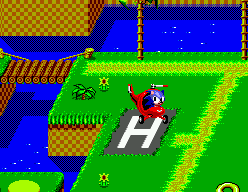
The world map gives the exercises a place to live. It is used to select levels, minigames and the options screen, while small interactive elements include cliffs to jump over, helicopters and a hot air balloon. I like the basic intention to let an educational program have a little room to move around. A hub can make a collection of separate tasks feel connected, and it can provide a change of pace between exercises. Here, however, I find the framework more appealing as an idea than as a reason to continue. Moving around the map does not change my reaction to the activities it connects. I do not need a large platforming adventure from a learning program, so the problem is not simply the limited scope of the hub. The problem for me is that the surrounding movement feels like an invitation to something more enjoyable than the exercises ultimately provide.
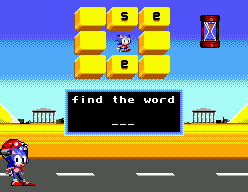
The main levels connect solving problems to moving a character forward. Correct answers contribute to reaching the end of a stage, making progress through an exercise visible through movement across the screen. I understand the logic of that connection. An abstract answer becomes a step toward a visible goal, and the exercise gains a simple sense of direction. My disappointment is that I do not find the two parts particularly satisfying together. The movement functions as a representation of progress rather than becoming an interesting interaction in its own right. That can be perfectly reasonable in educational software, but the problems themselves then need to carry the experience. For me, they do not create enough interest to make the race-like structure enjoyable. I am not asking for complicated action to replace the learning. I want the game elements to strengthen the educational activity, and the available prototype does not make that relationship work convincingly.
Spelling and letter-based tasks make up a substantial part of the material. Forming a word from the available letters gives the player a clear problem to solve, while the matching-letter interruptions introduce another kind of recognition task. I find the trust involved in that relationship especially important. An educational program has to give a learner confidence that the relationship between a correct answer and the response is dependable. The surviving prototype's problems with letter matching are therefore much more serious than a rough edge in presentation. An exercise that can reject a matching answer or fail to present a useful match undermines the very activity it is asking the player to understand. That uncertainty is a serious weakness in an activity that depends on giving a clear and dependable result. For me, uncertainty about the exercise's own logic is enough to make this a deeply unconvincing way of presenting a learning task.
The arithmetic material covers familiar operations such as addition, subtraction, multiplication and division. Those are reasonable subjects for the format, and I do not object to a Sonic-branded program asking for ordinary practice rather than inventing a new educational method. I do want the surrounding structure to make that practice appealing. A character advancing after an answer supplies a visible result, but it does not make the calculation more interesting on its own. I find the connection too thin to create much enjoyment. The program can present recognizable schoolwork, yet the presence of a familiar mascot does relatively little to change my reaction to carrying it out. That is not a criticism of arithmetic as a subject. It is a criticism of this particular attempt to connect the exercise to play. The available design gives the learning task a costume and a destination, but too little of an engaging relationship between the two.
The speed options at least do more than change a label. Choosing a faster setting changes the opponent and reduces the time available, making the race-like presentation more demanding. I appreciate that there is a real adjustment behind the choice, even if I do not enjoy the resulting activity. Time pressure can make a familiar problem feel more urgent, but urgency is not automatically helpful or entertaining in an educational setting. For me, it puts more weight on a structure I already find unconvincing. The three timed minigames provide another part of the package, with their own scoring framework, yet their presence does not solve my larger problem with how the exercises and the presentation relate. I am glad the prototype contains more than a single kind of screen. I just do not find the additional framework enough to turn its basic collection of tasks into an experience I can recommend.
There is a difference between preserving an unusual piece of Sonic history and enjoying it as a game or learning program. I think Edusoft has a clear place in the first conversation, because an unreleased educational experiment can show an unexpected use of a familiar character. My score belongs to the second conversation. The hub, racing presentation and recognizable exercises give me very little enjoyment, while the letter-matching problems make the educational logic particularly difficult to defend. I can acknowledge that this is unfinished material without pretending the available result is more rewarding than it is. Equally, I cannot judge a hypothetical finished release or assume what further work would have changed. What is here is enough for my own assessment to be strongly negative. I find it interesting to know that this prototype exists, but the interest comes from its place in the series' history rather than from the quality of the experience it offers.
Final thoughts
I find the available Edusoft prototype deeply unconvincing as an educational game. The hub and race-like progress do little to make the exercises enjoyable, and the letter-matching problems undermine the trust those exercises require. Its unreleased status matters, so this 1/10 is an assessment of the surviving prototype, not a claim about a nonexistent finished commercial release.
Final score: 1/10.
Reviewed on Sega Master System. No review copy was provided.
 Sonic Dash 2 Sonic Boom Review
 SONIC PICO PARK Review
 Sonic Rumble Review