Great music cannot make this much speed consistently enjoyable for me
Sonic Rush has energy to spare, but I do not find that energy as enjoyable as I want to. The boost, the tricks and the use of the DS screens make the game feel immediately different, and Blaze is a strong addition to the cast. I also love how much character the soundtrack gives the adventure. The problem is the balance between moving quickly and reading what is coming. Too often I am more aware of the interruption after a fast stretch than the satisfaction of handling the stretch well. Five out of ten is my score. I can appreciate the confidence and enjoy individual sections without finding the whole game consistently good. The music makes me want the platforming to feel better, while the platforming keeps giving me reasons to be frustrated. That gap between the presentation's appeal and the actual flow is what defines Rush for me more than its speed alone.
The boost system makes forward movement the center of the design. Tricks and other actions replenish the tension gauge, giving the game a way to connect what happens in the air with how aggressively the next section can be approached. I like that connection in principle. A successful trick can have a practical effect beyond an animation or a score, encouraging a rhythm between jumps and speed. When the stage supports that rhythm, the action can feel lively and direct. My reservation is how much of the experience depends on knowing what is ahead. Fast movement is satisfying when the important information arrives in time to make a useful decision. It is much less satisfying when a hazard or sudden change turns the same movement into an abrupt stop. I do not want Rush slowed into another kind of game. I want its chosen pace to be supported more consistently by stages that communicate their demands as confidently as they encourage the speed.
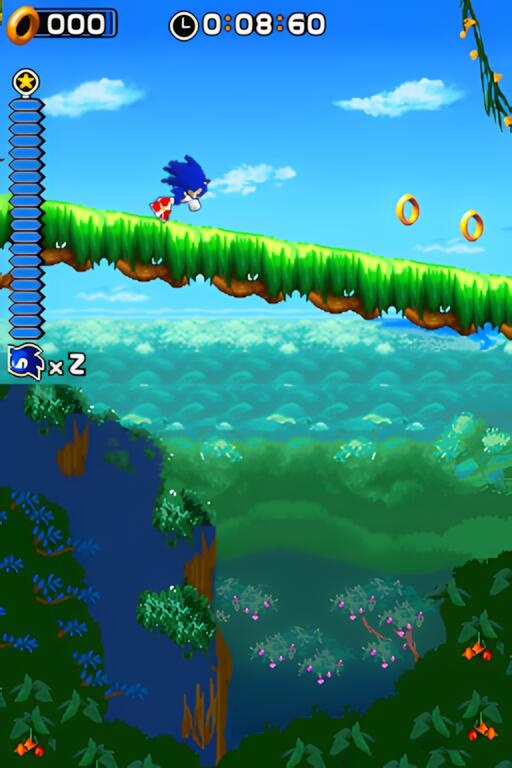
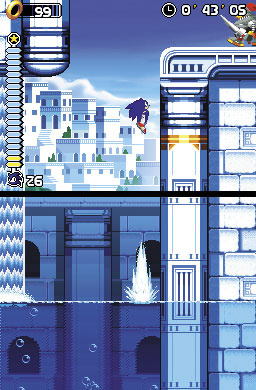
Using both screens creates a distinctive sense of height. Sonic and Blaze can move between the upper and lower parts of the display during the acts, giving a drop or a climb more room than one screen would provide. I like the attempt to make the hardware part of the stage presentation rather than reserving the second screen for a map. It does not make every vertical transition equally comfortable to follow. The change in where the action is happening can add another thing to track at a moment when the movement is already quick. That is not a reason to reject the idea entirely, but it is another part of the balance the game needs to get right. I enjoy the extra space when it helps reveal the shape of a route. I am less convinced when the presentation feels more interested in showing that the action can cross both screens than in keeping the next decision easy to read.
Blaze gives the package more personality than a simple repeat campaign would have. Her fire-based actions and different attitude make her feel like a character who belongs in this adventure, not just an unlockable appearance for Sonic. I like having another way to approach the stages, and the story gives her a useful place in the world rather than treating her presence as a bonus without context. The limitation is that another character cannot solve the underlying stage issues. If a route's hazards or pacing are frustrating, a variation in movement does not automatically turn it into a satisfying one. I enjoy the cast more consistently than the platforming, which is both a compliment to Blaze and a qualification on the rest of the game. The character is an appealing part of what Rush introduces. The adventure around her is much less persuasive as a reason to keep returning once the immediate novelty has passed.
The boss encounters interrupt the side-scrolling action with another kind of demand, and I do not find that change consistently helpful. A different perspective can make the encounter feel larger, but spectacle is not enough if the useful opportunity to act is less enjoyable than the waiting around it. I like a boss that gives the movement a focused purpose and lets an improvement feel clear. The stronger moments here can do that, while other sections make the rhythm feel stop-start in a way that is not especially satisfying. The stylus-controlled special stages are another experiment with the hardware. I can appreciate the change from ordinary directional input, yet I do not find the collecting challenge a strong enough reward to make the whole optional pursuit particularly exciting. Rush has several ways to vary its action. My mixed reaction comes from how often those changes create another small reservation instead of reinforcing the part of the platforming I already enjoy.
The soundtrack is the clearest highlight. It gives the stages an identity that is easy to recognize and makes the game's enthusiasm feel much more appealing than a generic set of fast tracks would. I like how strongly the music commits to its own sound. The colorful environments and character presentation support that confidence, giving Rush a coherent personality even when the action is frustrating. This is not a game I find boring to look at or listen to. The disappointment is that those qualities cannot carry the interaction for me. A great track can make another attempt more inviting, but the next attempt still needs enjoyable stage design underneath it. I keep finding individual stretches with the pace and rhythm I want, then another interruption that weakens the overall run. The presentation makes those stronger stretches memorable. It does not make the weaker ones disappear, which is why my score remains much more reserved than my praise for the music might suggest.
I land at five out of ten because the game stays mixed at its most important level: the ordinary experience of moving through a stage. The boost and tricks have a useful connection, Blaze is appealing and the soundtrack is excellent. I still find too many hazards and transitions less comfortable than the speed requires. The bosses and optional challenges add variety without consistently improving my enjoyment. I understand the appeal of a Sonic game this eager to keep moving, and I enjoy enough of its personality to wish the full experience worked better for me. It does not earn a stronger recommendation simply by being fast and distinctive. I need that pace to feel satisfying across the journey, and too often Rush makes the next interruption more noticeable than the next good decision. There are worthwhile ideas and very enjoyable moments here, but they never settle into a complete adventure I can recommend enthusiastically.
Final thoughts
Rush has a fantastic soundtrack, an appealing new character in Blaze and a lively connection between tricks and boost. I find the stage hazards, transitions and stop-start encounters too inconsistent to enjoy the whole adventure as much. The presentation is stronger than the platforming for me. 5/10.
Final score: 5/10.
Reviewed on Nintendo DS. No review copy was provided.
 Sonic Dash 2 Sonic Boom Review
 Sonic Rush Adventure Review
 SONIC PICO PARK Review