
A fun PSP rivalry that adds useful pressure to familiar side-scrolling movement
Sonic Rivals takes a simple idea and makes it entertaining enough to stand on its own: reaching the end is no longer the only goal, because another character is trying to get there first. I like how that extra pressure changes familiar platforming. A section can be easy to survive and still difficult to handle efficiently, while an attack or item can matter as much as the next jump. The PSP presentation gives the competition a clear personality, and the short races suit the portable format. The limits become more noticeable over repeated campaigns. The stages and interference do not always produce equally satisfying results, and the character variety is stronger in appearance than in the underlying actions. Seven out of ten is my score. It is a good spinoff with a useful competitive idea, held back by repetition and a few moments where the race feels less clean than the movement should allow.
The race changes what I pay attention to in a stage. A spring, a platform or a hazard is still something to negotiate, but the question also becomes whether the route preserves enough pace to stay ahead. I like that difference because it gives the familiar structure another purpose without abandoning it completely. The stage is not a background for a separate racing system; its obstacles are the race. A better jump or a more direct line can make a difference that is easy to understand. The reservation is that the course needs to communicate those opportunities comfortably. When a section is less readable or an interruption arrives abruptly, the competitive pressure can turn the frustration up rather than improve the challenge. I enjoy the game most when the rival makes a good route more demanding. I enjoy it less when the rival simply makes an awkward part of the layout feel more punishing.
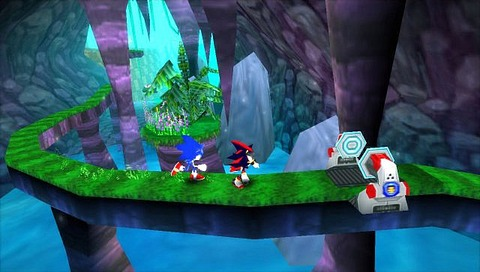
Direct attacks and items make the competition more active than two characters running separately toward the same finish. I like being able to affect the rival rather than treating them as a moving timer on the screen. The interaction can create a useful decision about when to interfere and when to concentrate on moving cleanly. It gives the race a more playful character than a pure time trial. The drawback is that interference can make a result feel less satisfying when it interrupts a good run without offering much useful response. A competitive platformer needs a careful balance between disruption and control. Rivals finds that balance well enough to be enjoyable, but not consistently enough for a stronger score. I like the idea of the opponent being part of the stage's problem. I do not always like how much a small collision or attack can dominate the immediate rhythm of a section that was otherwise working.
The boss races are a sensible extension of the same premise. Defeating the enemy before the competing character makes the encounter another contest rather than a completely unrelated break from the racing. I appreciate that the game carries its central idea into a different kind of stage. The challenge becomes reading an opportunity to attack while staying aware of the rival's progress. That can make a familiar boss pattern more urgent. It also introduces another place where the outcome depends on more than ordinary movement through a route. I find some of these changes more enjoyable than others, but the important point is that the game is trying to develop the rivalry rather than simply repeat the same finish-line demand forever. The structure gives a zone a clear progression, even if the final encounter does not always feel as satisfying as the stronger races leading toward it. The idea remains useful; the quality of its individual applications varies.
The character campaigns give the competition some context without changing the basic game dramatically. Sonic, Shadow, Knuckles and Silver have reasons to be involved, and I like seeing them placed in a direct rivalry rather than scattered across unrelated play styles. The limitation is that choosing another story does not create a completely different set of actions. The characters are more distinct as personalities than as fundamentally different ways to race. That makes repeated campaigns less fresh than the roster might first suggest. The game can still be enjoyable with a shared foundation, but it needs the stages and objectives to do more of the work. I would rather have a smaller amount of really strong competitive platforming than rely on the number of character perspectives to suggest more variety than the play actually provides. Rivals is worthwhile without being endlessly varied, and the distinction becomes clearer as the same environments return.
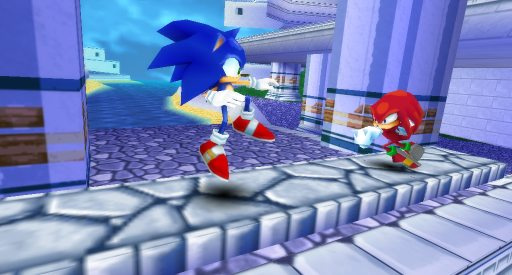
The collectible cards are a pleasant extra because they give the package something to pursue outside a straightforward story finish. Familiar artwork and box designs fit a Sonic game well, and I like having a visual reward for particular accomplishments. The cards do not need to alter the fundamental racing to make the system welcome. In fact, I prefer the main contest to remain understandable rather than have every collectible become another statistical requirement. The challenge objectives also give a race a more focused demand, which can make returning to an act more interesting than simply clearing another campaign. Those features provide worthwhile replay material, but their value still depends on enjoying the routes and the interference. A large card collection cannot make a repetitive race suddenly fresh. It can make a good race feel more rewarding, and that is where I find the extra structure most successful rather than as an independent reason to keep playing everything equally.
I finish Rivals with a positive recommendation that stays close to its central strength. Putting another character beside Sonic gives the platforming a clear competitive purpose, and the attacks, items and boss contests develop that idea enough to make the PSP release feel distinct. The presentation is appealing and the optional goals add useful reasons to return. Repetition, limited mechanical differences between characters and uneven moments of interference keep it at seven out of ten for me. I do not need the game to be a full console adventure to appreciate what it does well. I need the short races to make the movement and rivalry enjoyable, and a good amount of the package achieves that. The best sections have exactly the pressure I want from this idea. The weaker ones show how quickly the same pressure becomes irritation when the route or disruption is less carefully balanced, leaving a good game with clear limits rather than an exceptional one.
Final thoughts
Rivals makes a useful game out of racing another character through platforming stages. Attacks, items and boss contests give that premise variety, while the cards add replay goals. Repeated campaigns and uneven interference limit the appeal, but I still find the PSP competition entertaining. 7/10.
Final score: 7/10.
Reviewed on PlayStation Portable. No review copy was provided.
 Sonic Dash 2 Sonic Boom Review
 Sonic Rivals 2 Review
 SONIC PICO PARK Review