
More modes give the PSP sequel variety without making its rivalry consistently better
Sonic Rivals 2 gives its competitive platforming more options, but I do not find those additions enough to make the whole sequel more enjoyable. The central idea still works: running through a stage is more demanding when another character is trying to win the same race. I like the pace of the stronger routes and the way attacks can make the rival part of the immediate problem. The new battle demands and repeated story structure also expose the limits of that idea. Six out of ten is my score. I find the game worthwhile in parts, with a larger range of things to try than the first Rivals, but a less consistent sense of which ones make the platforming better. It is a sequel whose generosity is easier to appreciate than the rhythm of its complete campaign. I enjoy another clean race much more than another requirement added merely to make the next stage different.
The races remain the most direct attraction. A jump, a spring or an alternate line has a purpose beyond avoiding failure because every small delay can affect the contest. I like the pressure when the course is readable enough that a better run feels connected to better decisions. Sonic's movement fits this kind of competition naturally, and the PSP format suits stages that can give a clear result without becoming a long commitment. The weakness is how easily that result can be made less satisfying through interference or an awkward section. A rival should make the route more demanding, not make the underlying interaction harder to trust. The game achieves that balance in some places and loses it in others. I enjoy the cleaner stretches enough to keep the recommendation positive, while still finding the complete racing less consistent than the premise should allow. A familiar idea needs stronger execution to remain fresh, especially when the sequel asks for so many more visits to the same structure.
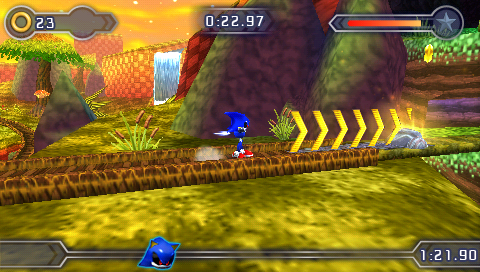
The battle modes are the most obvious attempt to add variety. Ring collecting, knockouts and objectives such as Capture the Chao change what it means to compete, giving the stages uses beyond a single race to the finish. I like having those alternatives available, particularly when I can choose the style that sounds appealing. They are less convincing when they become another required stop in the story. Not every arena-style demand feels as natural as moving through a route, and repeated exchanges can flatten the pace that makes the stronger races enjoyable. A different objective is not automatically an improvement just because it stops the next act from looking identical in a menu. I want the change to offer another enjoyable decision. Rivals 2 has good ideas in this area, but the quality varies enough that the expanded selection sometimes feels like extra work surrounding the main attraction rather than a more compelling version of that attraction.
Free Play is an addition I appreciate because it removes the competing character and lets the stages be approached on their own terms. It creates room to explore, look for hidden Chao or concentrate on a time without the same constant interference. I like the choice. A game built around rivalry can still benefit from allowing a different mood, especially when the player wants to understand the layout before another contest. The limitation is that taking the opponent away also shows how much of the stage's interest depends on the race. Not every route becomes an especially strong traditional Sonic level simply because it is now possible to move through it without a rival. The mode is useful without transforming the package into two equally substantial games. It gives the sequel more flexibility and makes the repeated environments easier to approach selectively, which is a better addition for me than simply forcing another battle into the story's next slot.
The larger cast has more character through its signature moves. Filling the meter creates an opportunity for an ability associated with the chosen racer, so the roster is not only a set of different appearances. I like that the game makes the characters relevant to the competitive interaction. The team-based stories also give the campaigns a useful frame, pairing familiar faces in ways that fit their personalities. My reservation is how much variety that frame provides in the actual play. Repeated stages and similar basic actions mean another perspective can feel more substantial in the dialogue than in the movement. A wider roster is welcome, but it cannot carry the whole sequel's sense of progression. The routes and objectives need to do that work too, and their uneven quality keeps me from being as enthusiastic about completing every campaign as the character selection might initially suggest.
The card collection and unlockable appearances give the package another set of rewards. I like seeing familiar artwork attached to accomplishments, especially when the goal encourages a cleaner or more focused attempt at a stage I already enjoy. The extra modes and customizable events also give the game a useful amount of flexibility outside the story. Those are genuine positives. They are not a solution to the repetition underneath them. A collectible reward can make a good run feel more satisfying, but it cannot make every battle or reused route equally interesting. The presentation remains attractive enough to keep the cast and environments recognizable, and the portable scale makes dipping into a chosen activity more appealing than treating the full campaign list as one continuous obligation. I enjoy Rivals 2 most in that selective way. The game becomes less convincing when the quantity of remaining goals is expected to provide the excitement that the next activity does not generate by itself.
I finish at six out of ten because the sequel's additions are useful without making its ordinary experience consistently stronger. The races can still be entertaining, signature moves give the cast a practical role and Free Play provides a welcome alternative to constant interference. The story's battle demands and repeated environments make the larger structure feel more tiring than I want. I do not think a competitive Sonic game needs to become a normal platformer to improve. I think it needs a clearer sense of which forms of rivalry make the movement enjoyable. Rivals 2 offers several answers and does not make all of them equally convincing. There is enough here to recommend a look, especially for the parts that let a clean route and a direct contest carry the action. The complete package is more mixed, with a larger list of features than consistently strong reasons to keep working through them.
Final thoughts
Rivals 2 adds useful choices through Free Play, battle modes and signature abilities. The clean races remain enjoyable, but mandatory battles and repeated routes make the campaign less satisfying than its feature list suggests. I like the flexibility more than the whole progression. 6/10.
Final score: 6/10.
Reviewed on PlayStation Portable. No review copy was provided.
 Sonic Dash 2 Sonic Boom Review
 Sonic Rivals [PSP] Review
 SONIC PICO PARK Review