
A maze built around the Spin Dash that makes moving Sonic feel much less enjoyable than it should
Sonic Labyrinth makes the Spin Dash carry almost the entire game. Sonic moves through isometric mazes, gathers keys and charges a burst of speed to reach the next useful place. I can understand the attempt to turn a familiar move into the center of a different kind of puzzle game. The result is not very enjoyable to me. Moving slowly into position, choosing a direction and releasing the charge makes the ordinary process of getting around feel too awkward for the small objectives being pursued. The game has a clear structure, and its clock gives the maze another consequence to manage, but I find little satisfaction in repeating the interaction. A four reflects that basic disappointment. I do not dislike the game simply because it changes the usual Sonic format. I dislike how the change makes controlling the character feel like the main obstacle between me and whatever the current maze is asking for.
The lack of a normal jump is a defining part of that control scheme. This is an actual restriction of the design, so the level has to be negotiated through walking, charging, rolling and using the environment to change elevation. I appreciate that a game can build a coherent activity around a small set of actions. The problem is whether those actions are satisfying enough to repeat. Here, walking feels more like positioning for the next charge than an enjoyable way to move through the maze, while the release requires a line and direction that the viewpoint does not always make comfortable to judge. The charge indicator shows the strength being prepared, giving the launch a visible state before Sonic moves. I like having that information, even though judging the resulting route remains awkward. Being able to stop the roll is useful, but it does not turn the whole process into something I find fluid. I want understanding a route and carrying it out to support each other. Labyrinth too often makes me notice the effort of the control before the pleasure of using it to solve the space.
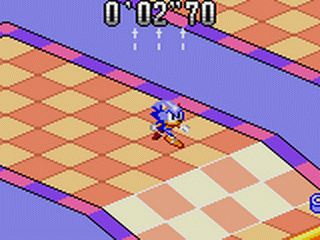
Collecting three keys opens the way to the exit in the ordinary acts. That gives each maze a clear objective and makes looking around necessary rather than incidental. I like having a simple requirement that can be understood quickly. The keys provide a reason to visit different parts of the arrangement, while the exit gives the exploration a destination. My reservation is that the objective becomes less interesting when the movement toward it is not enjoyable. Recognizing another place to search should make the next part of the route inviting. Here, it can feel like another reason to repeat the same awkward cycle of moving into position and charging away. The maze structure is not automatically the problem. A good maze can make a simple character action rewarding through the layout around it. I do not find that relationship strong enough in Labyrinth, so understanding what needs to be done offers more satisfaction than regularly doing it.
The timer gives ordinary damage a different meaning from the familiar ring-based protection. In the maze acts, time is the resource being threatened, and hits reduce it. Keys and defeated enemies can contribute more time, linking useful actions to keeping the attempt alive. I appreciate that the rule set is more specific than simply transplanting the usual health system into another camera angle. It gives the clock a practical relationship with the route. For me, however, the pressure makes the awkward movement less appealing rather than more exciting. I already want the character to feel more comfortable to guide through the space. Having time attached to the process makes every interruption more noticeable. The system has a reason for existing, but it does not solve my main problem with the game. It adds urgency to an interaction I would first need to enjoy much more before that urgency could become rewarding.
The scrolling sections and bosses change the rhythm from the key-gathering mazes. Rings collected in the downhill sequence provide protection for the following fight, giving those parts a more familiar Sonic relationship between collection and survival. I like that the game offers some contrast instead of asking the same maze question from beginning to end. Time Attack provides another context for the charged movement, asking for a quick route through a separate arrangement without the ordinary enemies and items. I like the clarity of that focused challenge, but it also puts the same control problem under a brighter light: speed matters more, while the movement remains the part I enjoy least. The isometric presentation also gives it a recognizable identity, with Sonic and the mechanical surroundings adapted to a compact overhead view. Those qualities provide some interest, but they do not overcome the regular frustration of moving around the ordinary acts. I am more interested in the different rules the game has assembled than in spending time with the actions those rules require. The package can vary the objective and the pressure while still leaving the fundamental interaction unsatisfying. For me, that keeps its more distinctive moments from doing enough to support a positive recommendation.
Labyrinth ends up as an experiment whose control idea is easier to understand than enjoy. Building a game around charging and releasing the Spin Dash is a reasonable starting point, and the keys, timer and separate encounters give it more structure than a single repeated obstacle. The problem is the regular work of navigating the maze. I find the slow positioning and charged movement too awkward to make searching the layout enjoyable, and the time pressure only makes those interruptions more prominent. That is a weakness at the center of the game, because moving through the space is what every objective depends on. I can appreciate the attempt to create another kind of Sonic experience without finding much pleasure in the result. My four reflects that poor balance: a game with understandable rules and a distinct presentation, but too little satisfaction in the act of controlling the character within them.
Final thoughts
I understand the idea of turning the Spin Dash into a maze-solving tool, but Labyrinth makes the regular movement awkward and unexciting. The key objectives and time-based damage have clear purposes without making navigation enjoyable enough. Its different sections provide some variety, yet the central interaction remains the problem. For me, it is a disappointing experiment at 4/10.
Final score: 4/10.
Reviewed on Sega Game Gear. No review copy was provided.
 Sonic Dash 2 Sonic Boom Review
 SONIC PICO PARK Review
 Sonic Rumble Review