A vertical Sonic detour with far too little fun in the climb
The original Sonic Jump is a game I find hard to enjoy beyond the immediate curiosity of its idea. Turning Sonic's movement upward instead of sending him across a stage is a reasonable way to adapt the character for an old mobile phone. A small game can be worthwhile without pretending to be a complete console adventure. The problem here is that the climb becomes dull long before the familiar name gives me a reason to care about another attempt. Two out of ten is my score. I am judging the older Java mobile game, not the later smartphone release, and the restricted format is part of its identity. That context explains why the design is small. It does not make the repeated platform-to-platform movement satisfying enough for me. I want a compact diversion to earn its place through an enjoyable central action, and this one offers too little pleasure in that action to support the time it asks for.
The automatic jumping gives the game a clear focus. The main job is to guide Sonic across the available landing points while the route develops vertically, so the usual running and momentum of the side-scrolling games are no longer the central concern. I like that the game tries to establish a distinct activity instead of squeezing a conventional Sonic into controls and space that may not suit it. The difficulty is making that activity interesting after it has been understood. A landing can be accurate without being exciting, and a chain of landings needs enough variety and rhythm to become more than a repeated correction. I do not find that rhythm compelling here. The climb feels functional in concept and thin in its actual appeal. Understanding what to do happens quickly. Wanting to keep doing it is the part the game does not establish nearly as well, leaving the main idea exhausted before the adventure has given me much else to enjoy.
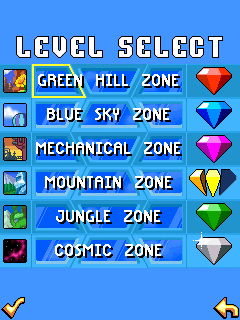
The vertical layout also changes what I want from the screen. In an ordinary Sonic stage, gaining speed can lead naturally into a new stretch of terrain or another route. Here the next useful information is the landing point above, and the interaction keeps returning to that same kind of immediate judgment. I can appreciate a game built around careful placement rather than speed, but the placement needs to feel rewarding on its own terms. I find the repeated ascent too limited in the decisions it makes interesting. It is not simply a matter of wanting Sonic to run again. I would happily accept a completely different kind of game if its new focus were strong enough. The familiar character is almost incidental to the weakness. Replacing Sonic with someone else would not make the basic climb much more attractive, which is a sign that the problem lies in the activity rather than in the fact that it departs from the platformers.
Rings give the stages a familiar object to collect and another reason to consider where to land. I like the principle of making an alternate line useful instead of asking only for survival. The Emerald-related reward for finishing with enough rings also gives collecting a larger purpose in the original game. Those additions are sensible, but I do not find them enough to make the route itself enjoyable. A reward can encourage another attempt without making that attempt more interesting. That is the distinction I keep coming back to here. I understand why the game wants me to preserve the ring total and make a cleaner ascent. I simply do not enjoy carrying out those demands enough for the final reward to feel worthwhile. Optional goals are strongest when they deepen a good central action. In Sonic Jump, they mostly ask for more patience with a central action that has already become unappealing to me.
The presentation supplies recognition more successfully than excitement. Sonic and the familiar style make it immediately clear what world the game is borrowing from, and that is useful for a small phone release with little room for a long introduction. I do not need elaborate scenery or a huge story from this kind of diversion. Clear visual information and an appealing rhythm would be enough. My reservation is that the familiar look does little to make the repeated movement feel better. I can recognize a Sonic object and still find its role here dull. That is why the license does not rescue the experience for me. The strongest portable adaptations make the character's identity part of an enjoyable design. This one relies too heavily on the character being recognizable while offering a much weaker reason to care about what is actually happening from one platform to the next. The result feels small in appeal as well as in scope.
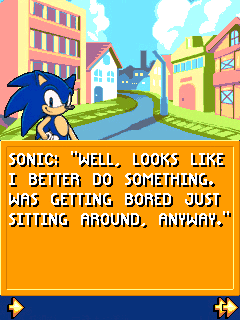
A short mobile game also needs a good reason to return after a mistake. A quick restart is useful only if the next attempt promises something enjoyable, whether that means a better line, a stronger rhythm or a more satisfying result. I do not find Sonic Jump persuasive on that point. Another climb often feels like another version of a task I already understood rather than a chance to enjoy a system more deeply. I can respect the simplicity without finding it rewarding. The game is not automatically bad because it has fewer actions than a platformer on dedicated hardware. It is bad for me because those few actions do not create enough pleasure or variety to hold the experience together. A modest design can be excellent when it makes one repeated thing feel good. This design makes its repetition much more noticeable than its skill or charm, which is a serious weakness for a game built around repeating that climb.
I finish the original Sonic Jump with very little desire to recommend it. The upward adaptation is understandable, the rings give the route a familiar goal and the small format is clear about the kind of diversion it wants to be. None of that changes how quickly I lose interest in the actual movement. Two out of ten reflects a game whose idea is easier to appreciate than its execution is to enjoy. I would rather have a shorter experience with a more satisfying action than a longer sequence of landings that never becomes particularly compelling. The Java mobile context matters when identifying the release, but it cannot do the work of making it fun. This is a weak Sonic detour with too little behind its central trick, and familiarity with the character only makes the lack of enjoyable momentum more obvious instead of giving me a reason to overlook it.
Final thoughts
The older Java Sonic Jump has a clear vertical-platforming idea, but the climb becomes dull quickly and the ring goals do little to deepen it. I appreciate the attempt to adapt Sonic to a small phone game without finding the result entertaining enough to recommend. 2/10.
Final score: 2/10.
Reviewed on Java mobile using Original Java feature phone (BlackBerry-type device, exact model not specified). No review copy was provided.
 Sonic Dash 2 Sonic Boom Review
 Sonic Jump Fever Review
 Sonic Jump (2012) Review