A clear mobile idea whose repeated climbing does too little to keep me interested
Sonic Jump on iOS turns Sonic into a vertical platformer, and I understand the appeal of that simple change immediately. Tilting to move across the screen while the character keeps bouncing gives the game a control scheme suited to a phone, and the familiar colors make the climb easy to recognize as part of the series. My problem is how little enjoyment I get from repeating that climb. There are hazards, rings and goals to consider, but the central action loses its appeal before the surrounding rewards become especially interesting. Four out of ten fits my reaction. This is the 2012 smartphone game, and I am not expecting it to behave like a normal console Sonic. I want its own mobile idea to be compelling enough that another attempt feels worthwhile. I can enjoy a brief stretch of it without finding that reason to return strong enough to recommend the complete experience.
The controls make a sensible first impression. Sonic jumps automatically, tilting adjusts the horizontal direction and a tap provides a double jump. I like that there is no elaborate collection of virtual buttons obscuring the small screen. The input has a clear relationship to the immediate task: line up with a platform, avoid a hazard and keep the climb going. That clarity is a useful foundation. It also exposes how limited my enjoyment of the repeated action becomes. Once the rhythm is understood, too many sections feel like another version of moving beneath the next surface and waiting for the jump to connect. The double jump adds a decision, but it does not consistently give the route enough variety to make the whole climb exciting. I do not need a phone game to have complicated controls. I need its small set of controls to keep producing situations I want to solve, and this one does not maintain that interest well enough.
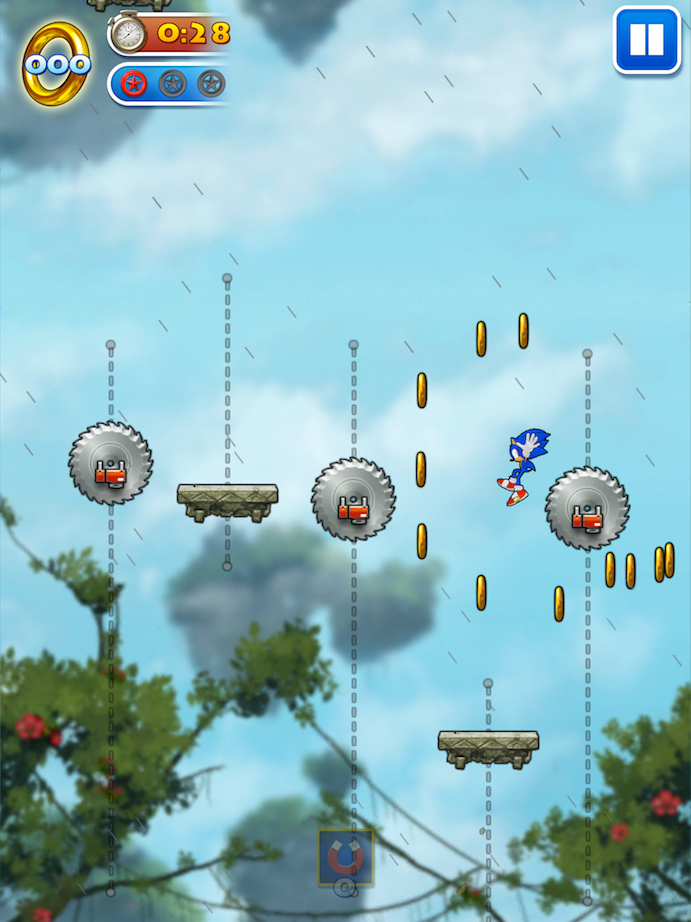
Story Mode gives the climbing a more defined purpose through stages with endpoints. I appreciate having a goal other than simply surviving until the attempt ends, because a designed finish can make a short outing feel complete. The familiar environments also give the next set of platforms an identity beyond a different arrangement of hazards. My reservation is that reaching another endpoint does not necessarily make the route to it more enjoyable. The main activity remains similar enough that the stage structure begins to feel more like a sequence to clear than a set of places I am interested in learning. A good platformer can get plenty of value from a modest number of actions if its spaces keep changing what those actions mean. Jump has some variations, but not enough of them make a strong impression on me. I like the decision to offer defined levels more than I like the full sequence that has been built around it.
Arcade Mode takes the same basic idea in an endless direction, making height and survival the reason to try again. That is an appropriate fit for a phone, and I can see the practical advantage of a game that begins quickly and has no large narrative commitment attached. I enjoy the immediate clarity of trying to keep a run alive. The trouble is that the desire to beat a previous result is not especially strong when the journey toward that result already feels repetitive. A score or a height total can make improvement visible, but the process of improving still needs to be enjoyable. I find myself noticing the repetition more than looking forward to another attempt. That is the difference between recognizing a well-understood mobile structure and actually wanting to spend time with it. Jump is easy to understand and can fill a small gap, but that alone does not make its endless variation a compelling use of my attention.
The rings and progression give the game additional goals outside a single climb. Collecting currency, completing objectives and opening access to more content provide a reason to pay attention to something beyond the next platform. I like the idea that an unsuccessful attempt can still contribute to a broader target. My disappointment is that the rewards do not change the core activity enough to overcome its limited appeal. An upgrade or another character can make a run more convenient or give it a different appearance, but the main question remains whether the climbing is enjoyable in itself. For me, the progression too often feels like a reason to repeat an action I am already losing interest in. It supports the loop without strengthening it enough. I would rather have more memorable stage situations than a longer chain of reasons to keep doing familiar ones, especially in a game whose controls are deliberately this simple.

The presentation is pleasant and recognizable. Sonic's cast and the bright scenery give the game a more inviting face than a generic collection of floating platforms would have, and the small-screen layout keeps the immediate objective easy to identify. I like that the familiar world has been adapted to the vertical format rather than being presented as an awkward imitation of a side-scrolling stage. That is a sensible piece of design. It does not make the game especially memorable once the novelty of the change has faded. The visual variety helps mark progress, but I rarely find myself excited by what another setting will ask me to do differently. The characters make the activity more appealing at first glance; the underlying repetition still decides how long I want to stay. I can appreciate the style without thinking it provides enough substance to make the whole package especially worthwhile, and the gap between those reactions is what keeps my opinion low.
My final score is four because the game is built around a loop I find too slight. The tilt-and-tap control is appropriate, Story Mode offers a clear endpoint and Arcade Mode supplies a straightforward score-chasing alternative. Rings and unlocks give both approaches some additional structure. Those are sensible ingredients, but the ordinary act of climbing does not stay enjoyable enough for me. I do not think a mobile Sonic needs to imitate the main games to be good, and I am not rejecting this one for choosing a different direction. I am disappointed because the direction it chooses runs out of interesting situations too quickly. A short attempt can be harmlessly pleasant, but the repeated attempts do not build into a stronger experience. The recognizable presentation gives it charm. The limited staying power of the actual platforming leaves me with little desire to recommend it beyond that first small burst of curiosity.
Final thoughts
Jump has sensible phone controls, a pleasant presentation and useful choices between defined stages and endless climbing. The core action becomes repetitive too quickly, and the progression does not make the repeated attempts much more appealing. I find the idea clearer than the lasting enjoyment. 4/10.
Final score: 4/10.
Reviewed on iOS using iPhone 13 Pro Max. No review copy was provided.
 Sonic Dash 2 Sonic Boom Review
 Sonic Jump Fever Review
 Mario & Sonic at the London 2012 Olympic Games Review