
An interesting puzzle curiosity with more appeal in its rules than its Sonic connection
Sonic Eraser is interesting to me precisely because it has so little to do with the platforming I usually associate with the character. It is a falling-shape puzzle game, built around managing space and matching pieces rather than running through zones. I enjoy that change of focus more than I enjoy its use of the Sonic name. The character provides a familiar identity, but the actual reason to keep playing has to come from the shapes entering the field and the decisions about where to put them. There is a reasonable puzzle game here, with enough variations to make it more than a single repeated exercise. My reaction is still fairly qualified. I like looking at the ways its rules change, yet I do not find the overall package especially compelling compared with the stronger puzzle games I would rather return to. It earns my interest as a small, unusual experiment, without becoming a favorite.
The basic interaction asks me to position groups of geometric shapes as they descend, make matches and keep the pile under control. Space is the resource that gives those actions meaning. An awkward arrangement matters because the next group still has to fit somewhere, and a useful match matters because it opens room for the decisions that follow. I like that immediate connection between the current move and the future state of the field. It is the sort of simple rule that can make a puzzle game easy to understand without making every placement equally sensible. For me, though, understanding the loop is more satisfying than the ongoing rhythm of working through it. I appreciate the decisions individually without finding the whole process as absorbing as I want. That is a fairly personal reservation, but it is also the difference between recognizing a sound mechanic and wanting to make it a regular part of my gaming time.
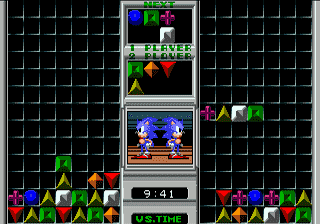
Normal Mode provides the clearest version of that loop. Matching shapes builds a score, and stronger performance raises the pressure as the falling pieces become faster. I like how the rising pace keeps a familiar rule relevant: the problem is not replaced, but the time available to solve it becomes more demanding. That lets the game ask for better judgment and quicker recognition together. My enthusiasm is limited by how much pleasure I get from the placements themselves. A higher speed can make a puzzle more urgent without necessarily making it more enjoyable for me. I want the relationship between recognizing a useful arrangement and carrying it out to feel especially satisfying. Here, that relationship works, but it does not become the main attraction I would hope for. I am more likely to appreciate the structure of the challenge than to feel a strong urge to keep extending another run of it.
Round Mode gives the rules a different purpose by organizing them into a sequence of puzzles. Clearing the designated pieces becomes the objective, with a time limit shaping how long there is to work through a round. I enjoy that change because it shifts attention away from maintaining an open-ended run and toward understanding a particular arrangement. A fixed problem can be rewarding in a different way from a continuous stream of pieces. I can focus on why one sequence of moves is useful instead of only managing the pressure of what might fall next. At the same time, this is where I find the game more interesting as an idea than as a lasting attraction. Learning the solution to a defined arrangement gives a clear piece of understanding, but it does not automatically make revisiting that arrangement exciting. I like the extra structure without feeling that it transforms the overall package into something essential.
Doubt Mode and Block Mode are worth acknowledging because they change the behavior of the pieces rather than only adjusting the pace. In Doubt Mode, a shape can become a white square when it lands, making the relationship between the falling group and its final state less straightforward. Block Mode changes how unsupported parts of a group behave, allowing arrangements to stand together instead of simply separating under the usual conditions. I like that these are actual rule changes. Calling the game a single mode repeated under different labels would miss some of its most interesting material. My reservation is that I find the distinctions more intellectually appealing than exciting in practice. They give me another reason to pay attention to the field, but they do not change my broader reaction to the feel of the game. There is variety here, and I can respect it without finding every variation especially enjoyable.
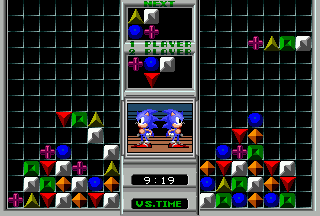
The multiplayer options give the Sonic characters a more visible function. Beyond competing for a score, the versus arrangement allows consecutive matches to trigger an attack that interrupts the opposing player's control of their pieces. I like how that connects offense to the puzzle actions already happening on the field. The character animation has a purpose within the match, rather than existing entirely outside the rules. It also creates a different kind of pressure: keeping my own arrangement healthy matters alongside building toward an interruption for the opponent. I would not dismiss that as meaningless competition. It is a real attempt to make the puzzle interactive between two sides. Even so, it does not quite turn the game into something I would strongly recommend for competitive play. The unusual mechanics remain the main reason for my curiosity, while the Sonic connection adds flavor more than it adds lasting appeal.
That is where I settle on Sonic Eraser overall. I find enough worthwhile ideas to enjoy examining it, especially the changes between its modes and the way competitive attacks grow out of matching pieces. I do not think its unfamiliarity should be treated as proof that it is either a hidden masterpiece or an embarrassing mistake. It is a modest puzzle game with a recognizable character attached, and the interesting parts are in the rules rather than the attachment. For me, the central loop never becomes as enjoyable as the variations suggest it could be. I can appreciate the thought behind the modes without feeling particularly drawn to keep playing them. A six reflects that combination of curiosity and reservation. There is something here for someone interested in unusual Sega puzzles, but I would recommend it with a clear explanation of its small scale and particular appeal rather than treating the Sonic name as a guarantee of excitement.
Final thoughts
I like the rule variations in Sonic Eraser more than I like its overall pull as a puzzle game. Normal, Round, Doubt and Block modes provide genuinely different considerations, and the competitive attacks give the characters a practical role. The core matching loop still does not hold me as strongly as those ideas suggest. It is an interesting curiosity and a qualified 6/10.
Final score: 6/10.
Reviewed on Sega Mega Drive. No review copy was provided.
 Sonic Dash 2 Sonic Boom Review
 SONIC PICO PARK Review
 Sonic Rumble Review