
A compact Sonic runner whose quick decisions are more appealing than its endless progression
Sonic Dash is a good fit for the part of Sonic that a short phone game can deliver well. The character keeps moving, the immediate route is clear and a swipe can turn the next obstacle into a small decision rather than a complicated input problem. I enjoy that directness. It gives a brief attempt enough energy to feel worth beginning, and the familiar characters and scenery make the presentation inviting. My reservation is how much of the wider game depends on repeating the same basic run for another target or unlock. Seven and a half is my score. The core activity is enjoyable enough that the repetition does not become a reason to reject it, but I value the moment-to-moment movement more than every system surrounding it. It is a worthwhile mobile Sonic whose appeal is strongest when I concentrate on reacting to the route, rather than treating the progression as a long-term commitment that needs to be maintained.
The lane-based controls are the strongest part of the design. Moving sideways, jumping and sliding are easy to understand, which lets the next combination of hazards create the challenge. I like that the game does not need an elaborate set of virtual buttons to make the character active. The important question is usually clear: which lane is safe, whether the next obstacle should be jumped or slid beneath, and how that choice affects the following one. A good sequence of those decisions gives an attempt a satisfying rhythm. The limitation is that the same clarity can become familiarity when similar arrangements keep returning. Dash depends on the immediate pleasure of reacting well enough that the repetition remains tolerable. For me it often succeeds, though I do not find every run equally exciting. The control scheme is appropriate because it makes the enjoyable part easy to reach, while the route still has enough demands to reward attention.
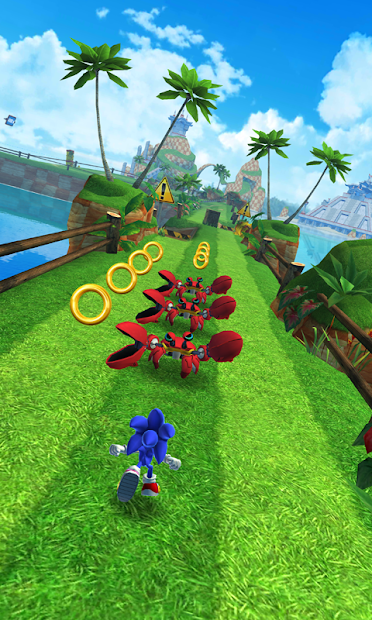
The dash itself adds a useful change of pace. Building toward a burst of protected speed gives the run another short-term target and makes a successful section lead into a recognizable payoff. I enjoy how that moment amplifies the sense of movement instead of replacing it with an unrelated activity. It makes the game feel like Sonic within the limits of an endless runner, which is more convincing than simply putting his model into a generic phone template. The contrast between careful reactions and the faster burst helps keep the rhythm lively. My qualification is that a temporary rush cannot provide all the variety a long sequence of attempts needs. It works as a reward inside a run, but it does not automatically make the next repeated objective more interesting. The basic lane choices still have to do most of the work, and the game is most successful when it trusts those choices rather than surrounding them with too many additional reasons to repeat them.
The scenery is another important part of why I enjoy it. The coastal colors and familiar Sonic imagery give the route a clear identity, and changing environments makes progress feel more visible than an uninterrupted strip of interchangeable obstacles would. I like how the world has been reduced into something readable on a phone without losing all of its personality. The boss encounters also interrupt the ordinary run with a more focused target, giving Eggman and Zazz a function beyond an appearance in a menu. I do not need those fights to become elaborate action stages. Their value is in briefly changing what deserves attention while staying connected to the movement. The presentation is strongest when it serves that purpose. A different setting or familiar character makes the next stretch more inviting, while the immediate hazards remain clear enough that the appearance of the world does not compete with understanding what needs to happen next.
The missions and unlocks give repeated attempts a wider structure. I appreciate having a small objective that can make a run useful even when it does not produce a new distance record. Another character or upgrade also provides a visible result for the rings collected along the way. Those features make sense in a game designed to be revisited. My reservation is that progression can become a more prominent reason to play than the route itself. When the next goal is mainly another accumulation target, the game feels less like a quick entertaining challenge and more like a routine waiting to be completed. I enjoy Dash most when I can take or leave that wider structure without feeling that a short attempt has become an obligation. The movement is good enough to justify a return. The collection systems are welcome when they support that enjoyment, and less appealing when they try to stretch it into something larger than the basic loop can comfortably sustain.
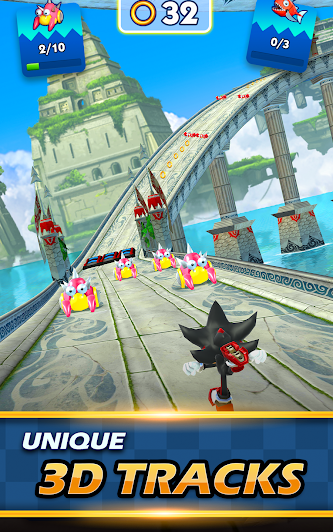
The expanding cast adds personality without changing my central judgment. I like seeing familiar Sonic characters presented in a format that is easy to begin, and their presence gives the rewards more appeal than a generic cosmetic counter would have. At the same time, another recognizable face cannot transform the fundamental experience of choosing lanes and timing a jump. I would not recommend the game solely because of how many characters it has accumulated. The better reason is that its immediate movement is enjoyable and its route is readable. That distinction keeps the praise proportionate. Dash is not a replacement for a designed Sonic platformer with individual stages and a more substantial sense of discovery. It is a different kind of game, with a smaller set of actions that can create a good short challenge. I enjoy it on those terms, while the limits of the format become more obvious when the surrounding progression asks for too much repeated attention.
My final opinion stays positive because the actual running is good enough to carry the package. The swipes are clear, the hazards create useful small decisions and the dash gives a successful stretch an appealing burst of energy. The scenery and characters make the experience warmer without being the only reason to care. Seven and a half out of ten recognizes those strengths alongside the repetition and the less compelling progression routine. I like Dash as a quick mobile game that understands how to make its few controls matter. I am less interested in treating every unlock or objective as something that needs to be pursued. That is a limit rather than a rejection. The best attempts give me the simple pleasure of reacting well and carrying the run farther, which is a convincing enough reason to recommend it. I just want the surrounding systems to remain secondary to that pleasure instead of becoming the main demand on my attention.
Final thoughts
Dash has clear swipe controls, enjoyable reactions and a protected speed burst that makes good use of Sonic's identity. Its scenery and cast help, while repeated objectives and unlocks are less consistently appealing. I recommend the immediate runner more strongly than the long progression routine. 7.5/10.
Final score: 7.5/10.
Reviewed on iOS using iPhone 13 Pro Max. No review copy was provided.
 Sonic Dash 2 Sonic Boom Review
 SONIC PICO PARK Review
 Sonic Rumble Review