
A fascinating Sonic adventure that makes exploration as important as speed
Sonic CD is one of the most interesting ways the classic formula has been taken in a different direction. It keeps the running, rolling and jumping that make Sonic immediately enjoyable to control, then builds an adventure where looking around can matter as much as moving forward. I love the ambition of that combination. The stages are places to revisit, understand and alter, rather than only routes to improve on another pass. The time-travel system gives that idea a clear identity, and the presentation makes its different versions of the world feel worth seeing. My reservations come from the friction between the freedom of Sonic's movement and the patience required to make the larger structure work. I find the game inventive and very enjoyable, but not always fluid. Its best ideas are excellent enough for a strong recommendation, even though some parts make me work harder than I would like to enjoy them.
The familiar controls still provide a strong foundation. Slopes, springs and changes of elevation make movement interesting, while the original CD version's charged Spin Dash and Super Peel-Out give Sonic ways to build speed. I like how those actions fit an adventure that can ask for both a careful search and a fast stretch of movement. Speed has a purpose within the time-travel system as well as within ordinary platforming, which gives the controls an additional relationship with the stage. At the same time, I do not find every layout equally accommodating. A place can contain several interesting paths while making it awkward to establish a clean line through them. That is where the game feels less graceful than the best of the Genesis sequels for me. The controls are appealing, but the space around them can interrupt the rhythm in a way that makes exploration feel more deliberate than effortless.
The time posts are the center of the larger idea. Passing one establishes a direction through time, but Sonic then has to maintain enough movement for the transition to take place. I enjoy that the act of traveling is connected to the character's defining ability instead of simply opening a menu. It makes a usable stretch of level something worth noticing. The same connection can also be a source of frustration, because a search for a suitable route can become more prominent than the excitement of reaching the other period. I do not think that ruins the concept. It gives the mechanic a physical relationship with the environment that is genuinely distinctive. I just prefer the moments when understanding the stage and carrying out the transition work together smoothly. When the layout interrupts the attempt, the time-travel idea can briefly feel like another task to arrange rather than an exciting extension of the movement.
What makes reaching the past worthwhile is that the world can be changed there. Finding and destroying the machines responsible for the bad future gives exploration a larger consequence than collecting something for a tally. I love how that makes the different periods part of the same place. A stage is not simply replaced by another background; the journey asks me to understand a relationship between versions of it. Good and bad futures give that relationship a clear visual payoff. For me, this is the strongest part of the design. It encourages curiosity without abandoning Sonic's controls, and it gives the scenery a purpose beyond being attractive to run past. I do not need every Sonic game to be built this way. I am glad this one commits to the idea strongly enough to feel distinct, because the exploration would be much less interesting if the different time periods were only a decorative effect.
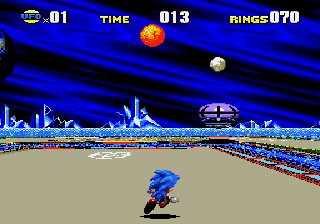
The special stages provide a separate route toward the game's larger optional goal through the Time Stones. Pursuing the UFOs in a timed, forward-looking arena feels very different from the normal side-scrolling stages. I appreciate that the challenge has its own visual and mechanical identity. It helps the package feel broader without simply adding more conventional acts. The controls and perspective can be awkward, though, and I do not enjoy every adjustment to the approach as much as I enjoy a clean stretch of normal movement. This is one of the clearest places where an imaginative idea and a consistently satisfying interaction are not quite the same thing for me. I like having the optional objective, and I like how recognizable the stages are. I would still prefer them to feel a little more natural to navigate. Their distinctiveness adds to the game, while their awkwardness remains part of why my recommendation has reservations.
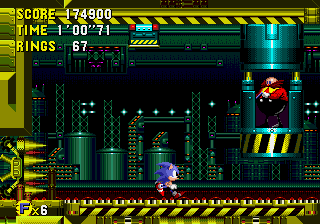
The presentation does an excellent job of making the unusual structure inviting. I love the contrast between the time periods and the way color, machinery and scenery can communicate a healthier or more hostile version of a place. The music gives the adventure a strong atmosphere, and the animated sequences help establish a more expressive Sonic identity around the platforming. Amy and Metal Sonic add memorable character presence without turning the game into something dependent on long stretches of explanation. The Metal Sonic race is particularly effective as a focused use of movement, placing a familiar action into a confrontation with its own clear personality. I enjoy how different the game can feel while still relying on the basics of controlling Sonic. Its identity comes from how those basics are arranged and presented, which is more compelling to me than simply adding a large number of unrelated activities around them.
My enthusiasm for Sonic CD comes from that willingness to make a familiar character serve a different structure. The time periods, the search through the past and the consequences for the future give the stages a kind of depth I find genuinely rewarding. The presentation supports that ambition beautifully. I do not find the overall flow as dependable as the strongest traditional Sonic adventures, because arranging a time jump or navigating a special stage can become more awkward than exciting. Those are meaningful reservations about how the game plays, rather than objections to it being different. I want its unusual ideas to work as smoothly as its best moments suggest they can. Even with those rougher connections, I think it is an excellent adventure and a very strong recommendation. Sonic CD gives me a reason to study the places Sonic runs through, and that is an imaginative use of the formula that remains easy to admire.
Final thoughts
I love Sonic CD for making its stages places to explore and change across time. The different periods, strong presentation and consequences of searching the past give the adventure a terrific identity. Setting up time travel and navigating the special stages can interrupt the flow, so it is not equally smooth throughout. Its creativity and best moments still earn an enthusiastic 8.5/10.
Final score: 8.5/10.
Reviewed on Sega CD. No review copy was provided.
 Sonic Dash 2 Sonic Boom Review
 SONIC PICO PARK Review
 Sonic Rumble Review