A charismatic Dreamcast adventure whose uneven ideas keep interrupting its best moments
Sonic Adventure is easy for me to like and much harder to praise without qualifications. It has ambition, a strong sense of personality and an exciting idea of what Sonic's world could become in three dimensions. When the speed stages click, the scenery and movement give the adventure a scale that still feels appealing. The trouble is how much less convincing material sits around those highlights. Different characters offer genuinely different activities, but that variety does not translate into equally enjoyable campaigns. The camera and the rough edges of moving around the world can also make a straightforward action feel less comfortable than it should. I enjoy enough of the game to value the experience, yet I cannot ignore how regularly its pace and precision let it down. Six and a half is the score that fits. It is an entertaining, memorable adventure with an uneven execution, and my affection for its personality does not make every part of playing it good.
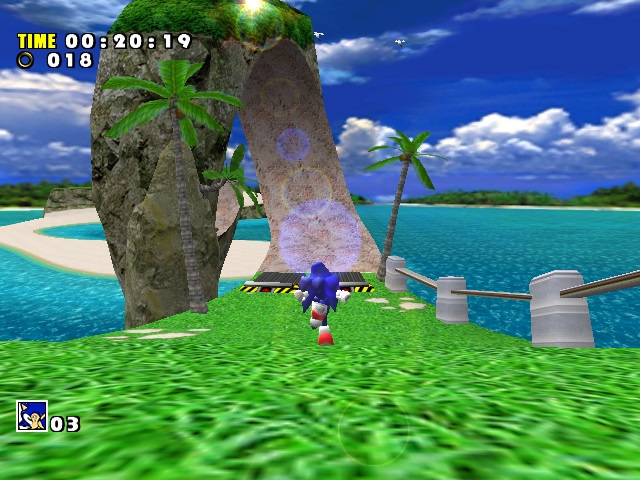
Sonic's stages are the clearest expression of the game I want this to be. Running through a three-dimensional environment gives the familiar jumps, enemies and springs a different sense of scale, and the homing attack helps connect actions that would otherwise be difficult to read in depth. I like the confidence of sending Sonic into large, varied spaces rather than keeping every section visually restrained. The most enjoyable stretches make moving forward feel exciting while still asking me to react. My reservations arrive when that confidence exceeds the clarity of the controls and camera. A game built around movement needs me to understand where a jump will go and what the view is showing. When those things become awkward, the spectacle loses some of its appeal. I can enjoy the speed and the scenery while still wanting more consistency in how they are handled. The strongest stages show why the idea works; the rougher interactions show why the execution needs more care.
The six-character structure gives the adventure breadth, but it is also the biggest source of its unevenness. Tails' racing changes the emphasis without abandoning movement, while Knuckles' treasure hunting turns the environments into spaces to search. Amy has a more cautious kind of progress with a threat pursuing her, Gamma's shooting adds a different pace and Big's fishing takes the game in a much slower direction. I appreciate that these are actual changes rather than six characters repeating the same objectives. I do not enjoy them equally. Some styles support the lively adventure better than others, and the shift into a less appealing activity can feel like being pulled away from the game's strengths. Variety is useful when it creates another reason to keep playing. Here it sometimes becomes an obligation between the parts I most want to return to. The cast is memorable, but a memorable character does not automatically have an equally compelling campaign attached to them.
The adventure fields help the world feel connected, and I like the intention behind them. Station Square, the Mystic Ruins and the other connecting spaces make the action stages feel as though they belong to a larger journey. Finding entrances and character upgrades gives movement outside a stage a purpose beyond walking to a menu. There is a sense of place that I would miss if the whole game were reduced to a simple list of levels. The cost is the interruption to the pace. Looking for the next step is not always as enjoyable as the destination, and an unclear direction can make a connecting space feel more like friction than discovery. I want the world to draw me toward something interesting rather than make me wonder which small interaction is holding the adventure up. The character-specific upgrades are a particularly useful reason to explore, since finding one can change what that character is able to do rather than only increase a completion count. The hubs are a good part of the game's identity, but they need a more comfortable balance between atmosphere, exploration and getting on with the action.
The presentation does a lot to make the uneven journey worth caring about. The characters have distinct attitudes, the music gives the different areas energy and the story is willing to give its central threat more weight than a simple excuse to run through another zone. I like the attempt to make the different viewpoints connect around the same larger events. The Chao Garden also provides a welcome activity outside the main stage progression, with raising the creatures offering a gentler reason to spend time in the world. It is a different kind of extra from another race or an unlockable picture, and its presence helps the game feel generous in its ideas. That generosity is also part of the problem. The adventure tries to accommodate many kinds of play without bringing all of them to the same level. I admire the amount of personality here, but personality cannot make the least enjoyable sections suddenly feel as polished or engaging as the best ones.
I finish Sonic Adventure with a mixed reaction that still leans toward enjoying it. The movement-focused stages, the music, the setting and the cast give it an appeal that is difficult to dismiss. There are enough good ideas to explain why this Dreamcast release matters to the series beyond the novelty of three-dimensional scenery. There are also too many uneven campaigns, awkward camera moments and interruptions to the pace for me to treat the whole thing as consistently excellent. I do not need every character to play exactly like Sonic. I need their differences to be enjoyable enough that changing perspective feels like a reward rather than a delay. The game reaches that standard in some places and falls short in others. Six and a half out of ten recognizes both sides of my reaction. I like this world and several of the things it lets me do, but the complete adventure is substantially less satisfying than its strongest moments suggest it could have been.
Final thoughts
Sonic Adventure has exciting speed stages, memorable music and a world full of character. Its different campaigns are far from equally enjoyable, while camera roughness and uneven pacing keep interrupting the appeal. I value the ambition and enjoy plenty of the journey, but the complete Dreamcast game stays mixed at 6.5/10.
Final score: 6.5/10.
Reviewed on Sega Dreamcast. No review copy was provided.
 Sonic Runners Adventure Review
 Sonic Dash 2 Sonic Boom Review
 Sonic Rush Adventure Review