
A well-defined puzzle battle whose pressure is much less enjoyable than its colorful personality
Dr. Robotnik's Mean Bean Machine has a bright, immediately recognizable personality, but its puzzle battles do very little for me. I can understand the rules and appreciate the logic behind the chains without finding the resulting pressure enjoyable. That is the central reason for my low score. The game asks me to build useful arrangements while an opponent threatens to complicate the field, and the pleasure is supposed to come from turning preparation into a large, well-timed attack. I find the process more draining than rewarding. The colorful beans and cartoon presentation make it inviting to look at, but they cannot make me enjoy the pace of the interaction. There is a real competitive puzzle system underneath the theme, so calling it mindless would be wrong. My problem is that understanding the system does not make me want to spend much time inside it. The experience remains an unusually poor fit for what I enjoy.
The basic rules are easy enough to describe. Colored beans fall in pairs, groups of matching colors clear, and the pieces above them drop into the spaces left behind. That movement can set up another clear, allowing a carefully arranged field to produce a chain. I like the intelligibility of the relationship: a placement changes the current board and can also prepare something useful for later. What I dislike is the pace at which maintaining that arrangement becomes the whole focus. I am more interested in having space to consider a structure than in watching the field repeatedly become a problem to repair. The game can produce satisfying-looking reactions, but I do not find that the visual result compensates for how much of the experience is spent managing pressure. The rules work together clearly. It is the feeling of having to keep serving those rules under competition that makes the game so unappealing to me.
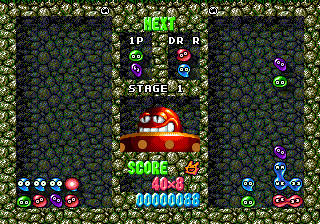
The nuisance beans make that pressure interactive. A strong clear or chain can send unwanted material onto the other side, turning the opponent's success into something that affects the shape of my own field. That is a meaningful competitive relationship, and it is important to the game's identity. I do not object to an opponent being able to interfere. I dislike how much the interference changes the mood of the puzzle for me. Building something useful already requires attention to what is on the board and what may fit next. Having that space repeatedly complicated by an attack makes the process feel more irritating than exciting. I can respect why that is the attraction for someone who enjoys competitive falling-piece games. For me, the tension overwhelms the pleasure of the construction. The game is effective at making the opponent matter, but the particular kind of pressure that results is one I find consistently difficult to enjoy.
Chains are the clearest example of why the game has more depth than its simple appearance suggests. A clear can change the field in a way that creates the next clear, so planning involves more than placing matching colors directly together. I appreciate that there is something to understand and improve. A good arrangement has a reason for working, and the result is connected to earlier decisions rather than only the latest pair of beans. My problem is that I find the learning process less inviting than the successful result makes it look. The ongoing competition keeps asking for an answer while I would rather have more room to understand the structure I am trying to build. That is a preference, but an important one. A puzzle can be intelligently designed and still give me little pleasure in the actual process of playing it. Mean Bean Machine repeatedly puts me in that position.
The single-player structure gives the competitive rules a succession of opponents, supported by the Robotnik theme and its animated personalities. I like that the package has a sense of character rather than presenting the puzzle field as a completely abstract exercise. The bright beans, expressive faces and cartoon framing are easily its most immediately appealing qualities for me. They make it understandable why someone might be curious about the game before knowing very much about the underlying rules. My disappointment is that the personality remains much more enjoyable than the battles it decorates. Moving to another opponent does not change my reaction to the central cycle of arranging, clearing and receiving pressure. I do not need the story to become elaborate, and I am not expecting Sonic platforming to appear inside it. I simply want the themed presentation to lead into an activity I find more entertaining than this one does.
Playing against another person gives the same attack-and-response structure a different social context, but it does not solve my basic problem with the rhythm. I can see the appeal of recognizing an opportunity to send a large amount of nuisance material to the other field. The rules make that confrontation easy to understand, and success can be traced back to how the board was arranged. For my tastes, though, the interaction still leans too heavily on a kind of urgency I find exhausting. I would rather enjoy the act of building a chain than spend so much attention on the threat of having the available space reduced. The multiplayer option is therefore a real part of the package, not an absent feature that would have rescued it for me. My low score comes from disliking the existing interaction, even when it is being used in the format that most clearly expresses its competitive purpose.
Mean Bean Machine leaves me with a clear distinction between recognizing its structure and enjoying its play. The color matching, gravity and chain attacks form a coherent puzzle game. The theme gives it a lively identity. Neither quality changes how little I enjoy keeping a field under control while the opponent adds more pressure to it. I find the challenge draining, the recovery irritating and the reward less satisfying than the effort leading to it. That is enough for a strongly negative recommendation from me, even though I can explain why the game appeals to people who like this kind of competition. It has a definite idea of what it wants to be, and that idea is simply not enjoyable for me. My three reflects the experience itself, with the colorful presentation offering more appeal than the battles underneath it.
Final thoughts
I like the colorful presentation of Mean Bean Machine much more than its puzzle battles. The chains and nuisance attacks have real logic, but the constant competitive pressure makes arranging and recovering the field feel draining rather than rewarding to me. Understanding the system never turns into wanting to keep playing it. For my tastes, the experience is a disappointing 3/10.
Final score: 3/10.
Reviewed on Sega Genesis. No review copy was provided.
 Onimusha: Way of the Sword Review
 Disney Speedstorm Review
 Zap Blastum Review