
An iconic arcade racer whose precision is easier for me to respect than enjoy
Daytona USA has a very clear idea of the race it wants to create. A stock car, a small selection of circuits and a crowded field put the focus on positioning, cornering and keeping a run together. I can understand the appeal of that concentration, and I like the confidence of the presentation around it. My own enjoyment of the driving is much more limited than the game's reputation might suggest. I find the regular work of judging the line and managing the car more demanding than satisfying. The colorful atmosphere and memorable music make it inviting, but they do not turn the racing into something I want to keep returning to. My five is therefore a mixed personal reaction rather than a claim that the game has no depth. There is a definite driving challenge here. It is simply a challenge I find more interesting to examine than consistently enjoyable to take part in.
The choice between automatic and manual transmission gives the driving a concrete difference in approach. Manual gearing makes the relationship between the car's speed and the next corner more involved, while automatic transmission offers a more straightforward way into the race. I appreciate that the game can present the same circuits through those different demands. It gives the controls a reason to be learned rather than reducing every lap to steering and accelerating without thought. For me, though, that learning is not especially inviting. I am more aware of the work needed to carry a useful line through a corner than the pleasure of coming out of it well. A racing game can make demanding control enjoyable when the action and result feel especially rewarding together. Here, I recognize the relationship without finding it compelling enough. That keeps the central driving from becoming the attraction it clearly needs to be for this focused package to work.
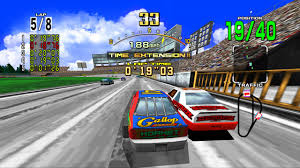
The three tracks make the game concise in a very deliberate way. They ask for familiarity, giving the driver a reason to understand the road and improve rather than simply moving through a long succession of new circuits. I like that a small amount of space can support a deeper relationship with the racing line. More tracks would not automatically make the game more enjoyable to me if I still felt the same way about driving them. At the same time, the limited selection makes my reaction to the central interaction even more important. There is less variation in setting to carry an otherwise unexciting experience. The game is asking me to find enjoyment in becoming better at a focused challenge. I can respect that intention while finding that the challenge itself does not give me enough pleasure. The compact design is coherent, but coherence alone does not make the next lap an appealing prospect for my tastes.
Traffic gives that focused challenge another layer. The other cars affect the space available for a useful line, so the circuit is not only a shape to memorize in isolation. I appreciate how a corner can mean something different depending on what is occupying the road. Positioning matters because a clear route is not always available exactly where it would be most convenient. Crashes can damage the car's performance, and the pit lane offers a way to repair it at the cost of time. Those are meaningful consequences inside the race. My reservation is that the resulting pressure feels more draining than exciting to me. I spend more attention on avoiding an interruption than enjoying the movement itself. The system gives mistakes a purpose and a cost, but it does not make the recovery or the continuing race especially satisfying for me. It is another part of the design I understand more readily than I enjoy.
The arcade multiplayer format is a substantial part of the game's identity. Linking cabinets allows several drivers to compete in the same race, making the crowded track a social confrontation as well as a driving test. I like the clarity of that attraction. The same circuit can become a shared problem in which positioning matters because another person is trying to use the space too. That is a worthwhile feature, not an imagined addition that would have rescued an otherwise solitary game. For me, though, the appeal of sharing the race still depends on enjoying the steering and the line through the track. The multiplayer arrangement makes sense around the driving; it does not change my underlying reaction to it. I can appreciate the importance of that format to the arcade experience while remaining only moderately interested in the actual racing it offers. The package has a strong social idea, but the road remains the part I find difficult to love.
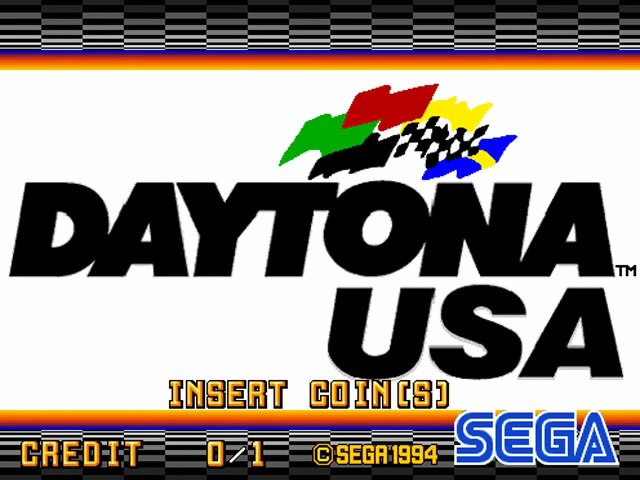
The presentation is where I find the most immediate pleasure. The recognizable Hornet, bright circuits and energetic musical identity make Daytona feel like a confident arcade attraction. I like how quickly it establishes its mood without requiring a story or a complicated introduction. The calls and sounds around the driving also give the race a strong personality. They make the experience easy to recognize even before the finer points of the controls become important. My disappointment is that the personality remains more appealing than the process of racing. A memorable song and a lively-looking circuit can make me curious about a game, but the next corner still needs to be enjoyable on its own. That is the gap I cannot quite get past here. I admire the way the presentation supports such a focused concept, while finding too little consistent enjoyment in the driving for that support to turn into a stronger recommendation.
I finish with a fairly neutral recommendation because Daytona's strengths are understandable without being especially persuasive for me personally. The gearing, traffic, damage consequences and small circuit selection give it a defined challenge. The linked-cabinet format and excellent sense of arcade personality make the package distinctive. I do not find the regular act of taking a corner and setting up the next line satisfying enough to want much more of it. That is a reservation at the center of the experience, and the attractive presentation cannot make it disappear. I would not recommend the game strongly on the assumption that its reputation guarantees enjoyment. I would describe what it actually emphasizes and let that emphasis define the appeal. For me, the result is a five: a racer with clear purpose and memorable style, but a driving rhythm I respect more consistently than I enjoy.
Final thoughts
I like Daytona's confident arcade personality and can appreciate the driving challenge created by its gearing, traffic and focused tracks. The actual cornering and repeated work of maintaining a useful line do not give me enough enjoyment to support a strong recommendation. The music and presentation are more immediately appealing than the racing beneath them. My personal score is 5/10.
Final score: 5/10.
Reviewed on Arcade. No review copy was provided.
 Onimusha: Way of the Sword Review
 Disney Speedstorm Review
 Zap Blastum Review