A richer Game Gear adventure that gives its small screen a much bigger sense of possibility
Sonic Triple Trouble is one of the Game Gear entries I enjoy most because it feels interested in giving the handheld adventure more room to develop. The familiar running, jumping and Spin Dash are still the foundation, but the stages have more space, the character choices are useful and the optional Emerald hunt gives the journey another worthwhile goal. I like how much personality the game gets from those additions without losing the clarity of the basic controls. It remains a compact handheld platformer, with some limitations in how comfortably everything can be read and negotiated. Those limits matter, but they do not define my overall reaction. I find Triple Trouble a substantial improvement in how inviting and varied this branch of Sonic can feel. An eight reflects a game with plenty of enjoyable ideas and a stronger sense of adventure than the lighter portable entries, even if the execution is not equally graceful throughout.
The larger stages are an important part of that appeal. A route can contain more to notice and more opportunity to understand how the space fits together, giving the movement a richer setting than a quick dash to the next exit. I enjoy having the familiar controls do more work through the arrangement of the level. The game does not need to add an entirely different activity every few steps to make exploration interesting. A useful slope, a concealed entrance or another way through a platforming section can be enough. The important thing is that the space makes those discoveries feel worth considering. Triple Trouble does that well for me. My reservation is that a larger handheld stage can also ask for more attention to a limited view. I appreciate the ambition while still finding some of the immediate reading less comfortable than the best parts of the design deserve.
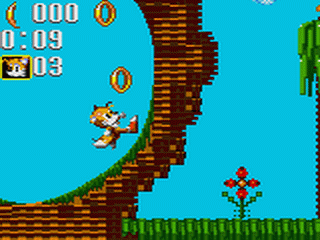
Sonic and Tails both have practical reasons to be chosen. They share the Spin Dash and the familiar platforming foundation, while Sonic's standing dash and Tails' flight change how a section can be handled. I like that the choice affects movement rather than only the appearance of the character. Flight gives Tails another relationship with elevations and gaps, while Sonic has his own way to establish a burst of speed. Both characters can participate in the special stages this time, which makes their place in the larger adventure feel more balanced than in Chaos. I enjoy having the optional objective remain relevant whichever character is selected. The different abilities give a familiar route another consideration without making the game feel divided into two unrelated sets of rules. It is a sensible use of the cast, and a large part of why returning to the adventure has more appeal for me than simply repeating the same character's route.
The ring system also takes a more forgiving approach to ordinary damage. A hit removes a quantity of rings rather than necessarily emptying the entire stock, changing how protection works during the normal stages. I appreciate that the game is willing to adjust an established rule to fit the adventure. It gives a larger collection of rings a different kind of value and makes damage less likely to turn immediately into the familiar scramble to recover a single ring. That does not remove the need to pay attention to the environment. It changes the balance between a mistake and the resources being carried through the level. For me, the result suits a game that wants exploration to be inviting. I like that the structure encourages looking around and collecting while allowing the stage to retain hazards that matter. The rule change gives the portable game another identity instead of treating every inherited mechanic as something that must remain untouched.
The Emerald hunt gives that exploration a clear reward. Finding the relevant monitor with enough rings opens the way into a special stage, so locating the entrance and managing the normal act become connected tasks. I enjoy that relationship more than a completely separate menu of optional challenges. The special stages themselves vary between side-scrolling activities and forward-looking Tornado sequences, giving the hunt more than one kind of movement to ask for. That variety makes the package feel more generous. I do not find every change of perspective equally comfortable, but I like that the additional material has a distinct identity. It gives a reason to care about what is hidden in the normal stages without making those stages feel like filler before the optional content. For me, Triple Trouble is strongest when its movement, exploration and collection goals reinforce each other, and the special-stage structure is a worthwhile part of that connection.

The presentation gives the adventure an appealing cast and a useful variety of moods. Knuckles and Fang, also known as Nack, contribute recognizable opposition around the journey, while Sonic and Tails remain the actual playable choices. I like how that makes the game feel busier and more expressive without requiring lengthy story scenes. The settings and character-specific items add to the same impression. A different movement opportunity or a change of environment can make the next part of the journey feel worthwhile to see. My reservations are about consistency rather than a lack of ideas. Some arrangements are more enjoyable to understand than to move through immediately, and the limited view can make the larger ambitions less comfortable. Even so, the game has enough charm and variety that those interruptions do not outweigh my enthusiasm. It feels like a handheld adventure with a proper interest in its own possibilities.
I recommend Triple Trouble positively because it makes several good improvements feel connected. The larger stages invite curiosity, the characters give movement a useful choice, and the Emerald hunt adds a reason to pay attention beyond reaching the exit. The more forgiving ring rule also fits that inviting direction. I still notice the compromises of fitting the adventure into a small view, and I do not enjoy every special-stage or platforming arrangement equally. Those are reasons to keep the recommendation qualified, not reasons to dismiss the design. For me, an eight reflects one of the more satisfying Game Gear Sonic adventures. It has enough individual character to be enjoyable on its own terms and enough development of the handheld formula to feel like more than another quick variation. I like how much it tries to offer, and I enjoy enough of that ambition in practice to recommend it confidently.
Final thoughts
I enjoy Triple Trouble for its larger stages, useful character differences and worthwhile Emerald hunt. The more forgiving ring system helps exploration feel inviting, while the special stages and cast give the adventure extra personality. Some arrangements remain awkward within the small view, but the overall experience is rich and enjoyable for this handheld branch of Sonic. It earns a confident 8/10.
Final score: 8/10.
Reviewed on Sega Game Gear. No review copy was provided.
 The Murder of Sonic the Hedgehog Review
 SEGA AGES Sonic the Hedgehog 2 [Switch] Review
 SEGA AGES Sonic the Hedgehog [Switch] Review