A lively arcade escape with a control scheme that gives Sonic a different kind of urgency
SegaSonic the Hedgehog is appealing to me because it takes the character into an arcade format that has a clear reason to feel different. The isometric viewpoint, trackball movement and constant environmental danger create an adventure built around escaping what is happening on screen. I like how quickly that purpose becomes understandable. This is not an attempt to reproduce the Genesis stages from another camera angle. It is a more immediate, forward-pushing experience in which the next hazard is often the main concern. Sonic, Mighty and Ray give it a memorable cast, while the presentation makes the danger playful enough to fit the series. My enthusiasm is qualified by how much the attraction depends on the physical controls and the compact arcade structure. I find it inventive and entertaining, but less broadly satisfying than the stronger conventional platformers. It is a worthwhile change of form with some clear limits to its appeal.
The trackball is central to that reaction. Rolling it directs the character around the isometric spaces, while a separate button supplies the jumping Spin Attack. I enjoy how direct the relationship is between moving the ball and trying to guide a character away from danger. It gives the game a physical identity that a normal directional pad would not reproduce in quite the same way. At the same time, the viewpoint asks for careful judgment of where a platform or safe space actually lies. That combination can make the movement more demanding than the simple list of controls suggests. For me, the pleasure comes from connecting the physical input with a readable escape route. When the space is clear, the urgency works very well. When judging the next movement becomes less comfortable, the same urgency can make the game feel more abrupt than satisfying. The unusual control is both a major attraction and a meaningful qualification.

The environments are more important than ordinary enemy encounters. Boulders, lava, machinery and other hazards keep the characters moving, giving a stage the feeling of an escape sequence rather than a search through a large platforming space. I like that commitment. The game does not need to pause constantly for conventional fights to create something interesting to do. A changing obstacle can be enough when the character's position matters and the pressure is immediate. The visual events also give the action a lively personality, making the danger something enjoyable to watch as well as something to avoid. My reservation is that constant pressure leaves less room for the slower pleasure of understanding a place. That is not a missing feature the game promised to provide. It is simply a difference in appeal. I enjoy the fast reactions and spectacle, while finding the broader sense of exploration less satisfying than in the platformers I prefer.
The three-character cast is another part of what makes the arcade game memorable. Sonic, Mighty and Ray are all available, and the cabinet can support all three players at once. Their different appearances do not mean that they have the later abilities associated with other games; here, they share the same basic play. I like that the presentation gives the group personality without requiring a separate set of rules for each character. In a game built around reacting to immediate hazards, a common control language makes sense. The shared action also creates a clear social appeal, because several characters can be trying to negotiate the same dangerous sequence together. The shared screen is an appealing part of the design, even though the common controls make the character choice more about personality than a different gameplay role. The cast broadens the identity of the adventure without turning it into a complicated character-management game.
Rings work differently from the usual classic Sonic safety net. They restore health, so gathering them contributes to staying in the escape rather than only protecting a stock of rings from a single hit. I appreciate how that gives collecting them a purpose suited to this version of the action. They can be part of navigating a dangerous space rather than a separate distraction from it. The end-of-stage tally also gives the collection a performance element, rewarding attention to what was available along the way. I like having that additional consideration inside a game that otherwise pushes forward so firmly. It creates a reason to notice more than the immediate exit. At the same time, I do not find the collection framework enough to turn every repeated attempt into a richer adventure. It adds a useful layer, but the main appeal remains the physical movement and the changing sequence of environmental threats.
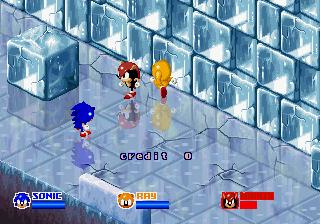
The animation and character reactions help those sequences feel entertaining instead of merely hostile. I enjoy the expressive way the game presents danger, with recognizable characters reacting inside spaces full of large moving threats. The voices and onscreen dialogue add to that personality, giving the arcade adventure a different kind of presence from a mostly silent run through a side-scrolling stage. It feels like a confident use of an arcade machine's ability to create a quick visual impression. I do not need it to become a long story to appreciate that effect. My reservation is about the balance between watching an event and responding to it comfortably. A dramatic obstacle can be fun to see while still placing a demanding movement in front of the player. The best moments make those two parts work together. That connection is strong enough to make the presentation a real attraction, even when the overall experience is more forceful than fluid.
I come away from SegaSonic feeling that its unusual format has a genuine purpose. The trackball, isometric spaces and environmental escape sequences give it a distinct identity, while the three characters make the arcade presentation especially memorable. I enjoy it more as a focused, physical burst of action than as an adventure I would recommend to everyone who likes Sonic. The camera angle and urgency can make movement demanding, and the compact structure offers a different kind of satisfaction from exploring a fuller platforming journey. Those limits matter to my score, but they do not make the experiment unsuccessful. There is enough imagination and energy here for a positive recommendation with clear qualifications. For me, a seven and a half reflects a game that makes its differences interesting, even if those differences also keep it from becoming one of the Sonic adventures I find most consistently enjoyable.
Final thoughts
I enjoy SegaSonic for giving Sonic, Mighty and Ray a distinctive arcade escape built around trackball movement and environmental danger. The expressive presentation and shared-screen format have real charm. The viewpoint, physical input and constant urgency also limit how comfortable and broadly appealing I find it. It is an inventive, energetic 7.5/10 with a clear identity of its own.
Final score: 7.5/10.
Reviewed on Arcade. No review copy was provided.
 The Murder of Sonic the Hedgehog Review
 SEGA AGES Sonic the Hedgehog 2 [Switch] Review
 SEGA AGES Sonic the Hedgehog [Switch] Review