
A striking road trip that gives me too little reason to keep driving
Rad Mobile has a much better opening idea than the game it becomes for me. A coast-to-coast race across America, seen from inside the car, sounds like a great excuse for Sega to mix speed with a changing sense of place. Traffic, police cars and the checkpoint clock all give that journey something to push against. I understand the appeal immediately, and I like the ambition of making the road feel bigger than a short circuit. What disappoints me is how quickly my interest settles on the scenery instead of the driving. The basic pressure to reach the next checkpoint does not give me enough satisfaction to make the whole trip compelling. There is activity on the road, and there are real controls to manage, but I do not find their combination especially rewarding. That distinction matters: this is not an empty demonstration with nothing to do. It is a playable arcade racer whose central routine simply leaves me cold.
The cockpit view is easily one of its most attractive choices. Seeing the road framed by the car gives the action a clear identity, and the little Sonic ornament hanging from the mirror adds a memorable detail. I like that touch, although it is incidental to the actual game. Sonic is not the driver or a playable character, and judging this as a Sonic platformer would make no sense. My problem is that a convincing viewpoint can only carry the driving so far. Once the initial visual appeal is established, steering through traffic still needs to feel interesting on its own. For me, the road view is more successful at selling the idea of a long journey than the underlying interactions are at sustaining it. I can appreciate what the presentation is attempting without wanting to excuse the weaker entertainment underneath. The car is a good place to put the camera; that does not automatically make it a good place to spend the whole game.
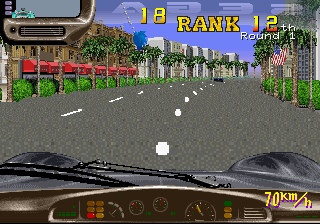
Checkpoint pressure is the main source of urgency, and it is also where the design loses me most. The clock makes speed necessary, while traffic means that simply keeping the accelerator down is not enough. Steering, braking and judging the space between vehicles are part of the challenge. I do not object to those fundamentals. They are sensible ingredients for an arcade driving game. What I dislike is how little the constant demand to keep moving does to make the next stretch feel exciting to me. Maintaining a run becomes a duty rather than a pleasure. A near miss can be tense, but tension by itself is not the same as an enjoyable rhythm. I want the act of threading through the road to provide the reason to continue, rather than relying on the clock to supply that reason. Rad Mobile's priorities are clear; they just do not produce a driving loop that I find satisfying enough.
Changing weather and visibility are more interesting ideas than the basic checkpoint routine. Darkness calls for headlights, while rain makes the windshield wipers relevant. Those are actual actions the player performs, and I appreciate the attempt to connect the car's equipment to the conditions outside. They make the cockpit more than a decorative frame. Even so, I find them more appealing as details than as a lasting reason to enjoy the race. They add another thing to notice and another input to make, without changing my overall reaction to the driving. Fog and rain can give a stretch of road a different atmosphere, but the continuing focus is still on navigating traffic and protecting the run against the timer. I do not need a complex simulation from a game like this. I do need its simple actions to add up to something more enjoyable than they do here, and the visibility changes do not quite make that happen.
The cross-country structure at least gives the presentation room to change. This is a journey through stages rather than a race around one endlessly repeated circuit, and there are forks that can let the player skip portions of the route. I like that the road is not presented as one completely inflexible line. Those choices are worth acknowledging, especially because calling every stretch identical would miss what the game is trying to do. My disappointment is more personal and more specific: the broader trip remains more interesting to imagine than to play. Changing the backdrop or the route does not solve my lack of enthusiasm for the checkpoint chase itself. I can recognize variation without finding it particularly compelling. The scenery supplies a sense of travel, but it cannot do all the work of making the driving entertaining. For my taste, the balance puts too much weight on what is passing outside the windshield and too little on why I should care about the next corner.
I also find the game's historical interest easier to recommend than the game itself. Sonic's small appearance is a fun connection, and the large, colorful road view makes it easy to understand why an arcade machine like this could attract attention. There is value in looking at an older game and appreciating its visual ambition on its own terms. I do not expect a modern open world, elaborate vehicle customization or a huge collection of modes from this kind of arcade racer. Those would be the wrong standards. My lower score comes from the experience at the center of the machine, not a checklist of later features it never promised. A simple score chase can be plenty when the controls, pressure and repetition are enjoyable together. Here, I do not find enough pleasure in repeating that central challenge to give the visual achievement much room to matter. Curiosity is a reason to look; it is a weaker reason to keep playing.
That leaves Rad Mobile as a game I appreciate in pieces but cannot recommend enthusiastically as a whole. The viewpoint, changing visibility and cross-country premise are all ideas I can understand and, in places, admire. They give it a personality that would disappear if it were reduced to a generic description of cars and checkpoints. But personality is not enough to make the road itself feel rewarding to me. The traffic and timer keep the action occupied without keeping me especially interested, and the journey never becomes the entertaining escape that its premise suggests. I can see why someone drawn to older arcade racers would want to explore it, particularly for its presentation and place in Sega's history. My own judgment is much less generous when it comes to the actual fun. I would rather have a less impressive view paired with a more satisfying race. For me, the good ideas around the driving are considerably stronger than the driving they surround.
Final thoughts
I like the cockpit presentation and the attempt to turn changing visibility into part of the driving, but the checkpoint chase does not hold my interest. Rad Mobile gives its cross-country trip a memorable look without making the traffic-and-timer routine rewarding enough for me. The Sonic ornament is a fun historical detail, not a reason to overlook an otherwise disappointing arcade racer.
Final score: 3/10.
Reviewed on Arcade. No review copy was provided.
 PUBG Mobile Review
 Sonic Unleashed (Mobile) Review
 Onimusha: Way of the Sword Review