A worthwhile mobile battle royale whose best decisions are clearer than its crowded surrounding package
PUBG Mobile is enjoyable because the battle-royale structure gives ordinary decisions weight. Where to land, what equipment to keep and when to leave a useful position can matter as much as the next exchange of shots. I like that the game has room for preparation and observation rather than asking every second to be immediate combat. My enthusiasm is more qualified around the mobile interface, the repetition of familiar early tasks and the amount of surrounding live-service activity competing for attention. Seven out of ten is my score. The central survival competition is strong enough to recommend, with good reasons to think about space and risk, but the complete package is not equally comfortable or engaging at every moment. I enjoy the core most when a clear tactical decision leads naturally into the next situation. I enjoy it less when the interface and the surrounding layers make that clear loop feel busier than it needs to be.
The opening choice gives each match a useful direction. A crowded landing area can promise equipment and immediate danger, while a quieter start can create more room to prepare at the cost of another journey afterward. I like having to decide what sort of risk is acceptable rather than beginning every attempt with the same conditions. The uncertainty is part of the appeal. Another player may value the same location, and the equipment found may suggest a different plan from the one originally intended. That makes the first stretch of play meaningful even before a direct confrontation occurs. The limitation is that familiar looting can become routine when the match has not yet produced a more interesting problem. Preparing is satisfying when it supports a plan. It becomes less engaging when the process feels like repeating an opening sequence before the part I am most interested in can begin. The structure has both effects, which is why the pacing feels enjoyable in some moments and slow in others.
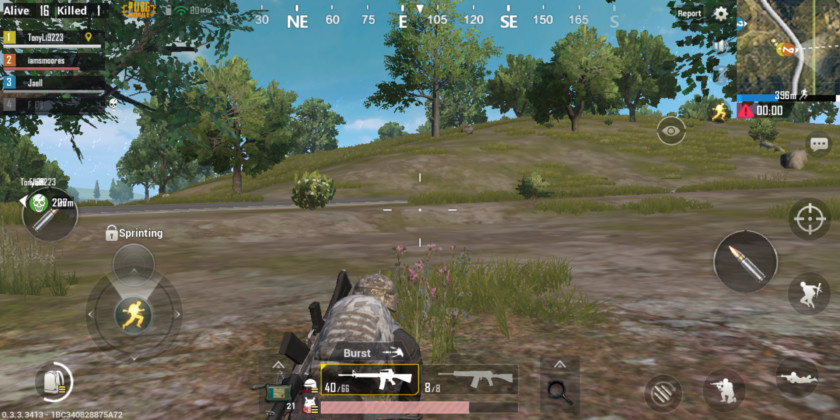
Equipment gives those early choices a practical consequence. A weapon changes the distance and conditions in which an encounter is comfortable, while protection and supplies affect how much risk can be accepted before the next recovery is needed. I enjoy the need to work with what is available instead of treating an ideal loadout as guaranteed. The game is strongest when that adaptation remains connected to positioning. Good equipment helps, but entering a bad area or exposing the wrong angle can still make the situation difficult. That gives the player a reason to think beyond a list of items. The shooting needs to feel readable enough that a useful decision can be carried out, and the phone interface adds another layer to that requirement. I appreciate the amount of action the mobile version makes possible, while still finding the crowded collection of touch inputs less comfortable than the clearest parts of the tactical idea itself.
The shrinking playable area prevents a safe position from becoming the entire solution. A location can be useful now and inconvenient shortly afterward, so moving becomes a decision rather than neutral travel between fights. I like how that pressure makes the landscape relevant. Cover, height and the available route can all change what the next journey should look like. A vehicle offers another option, but traveling quickly and traveling discreetly are not automatically the same goal. That is the kind of practical tradeoff I enjoy in the format. The frustration is the uneven rhythm created by the larger match. A quiet journey can be tense when the surrounding risks are understood, and dull when it mainly postpones the next useful choice. I do not need constant gunfire to stay interested. I do want the space between encounters to continue offering something worth considering. The game often manages that, but not consistently enough for every stretch to feel equally purposeful.
Sound and awareness give the encounters more substance than simply aiming at whatever is directly ahead. Information about movement or an attack can change whether it is sensible to stay, advance or look for another angle. I enjoy that attention to the surroundings because it makes a fight part of the larger space rather than an isolated test of reaction. Team play adds another useful set of possibilities through shared information, support and coordinated movement. It also creates another source of uncertainty, since a plan depends on several people interpreting the same situation. The game can be exciting when those decisions support one another and more frustrating when the group pulls in incompatible directions. I value the option without assuming that every shared match will produce the same kind of experience. The tactical foundation is worthwhile in either context, while the social demands change how comfortably its possibilities can be used.

The mobile presentation has the difficult task of communicating a large amount of information without making the screen feel like a collection of controls rather than a view of the world. I appreciate the accessibility of having this kind of battle royale on a phone, and the core ideas survive the format well enough to be enjoyable. I am less enthusiastic about the layers of menus, rewards and changing activities around that core. More content can be useful, but it can also make the package feel less focused when I simply want a clear route into another match. The strongest reason to return is still the competition itself. I do not need every new visual theme or reward prompt to justify the game. I would rather the presentation make the central decisions easy to read and the next match easy to reach. The surrounding quantity is less impressive to me than the clarity of a good encounter.
I finish PUBG Mobile with a positive recommendation at seven. Landing choices, equipment, positioning and the changing safe area create a worthwhile survival loop, and the game has enough tactical room to make another attempt interesting beyond the immediate result. The slower repetition, crowded touch interface and busy surrounding package keep the score qualified. I enjoy the format most when preparation and action feel connected, with a useful choice about the landscape leading into a fight that can be understood and responded to. I am less interested when another familiar sequence or another layer of live-service presentation becomes the main thing demanding attention. The game has a strong foundation, and the mobile version preserves enough of it to be worth playing. It simply does not make every part of accessing and repeating that foundation equally comfortable or equally engaging.
Final thoughts
PUBG Mobile has a strong survival loop built around landing, equipment, positioning and a changing safe area. I enjoy the tactical decisions, but familiar early repetition, crowded touch controls and busy surrounding systems qualify the recommendation. The central competition is more appealing than every layer around it. 7/10.
Final score: 7/10.
Reviewed on iOS using iPhone 13 Pro Max. No review copy was provided.
 Sonic Unleashed (Mobile) Review
 Rad Mobile Review
 Onimusha: Way of the Sword Review