I wanted to like it, but the DUST: Origins playtest is slow, dull and buggy from one end to the other.
DUST: Origins arrives with a pedigree that made me pay attention. It comes from Airship Syndicate, the studio founded by Joe Madureira and the people behind Darksiders, Battle Chasers: Nightwar and Ruined King. On paper the pitch is strong: an isometric horror shooter set on Limbo-6, an orbital prison platform that is falling apart above the prison planet Dross, with an inmate who wakes up from cryostasis and has to fight his way off the station before it tears itself apart. Scarce ammunition, crafting, survivors with their own agendas, multiple endings and a promise that your actions have consequences. That is a list of ideas I usually enjoy. After a little over three hours with the November playtest build on Steam, I came away with the opposite of what that list suggests. What I played is slow, boring, tedious, buggy, tiring and weak, and the strong art direction only makes the gap between the promise and the result more obvious.
I want to be clear about what this review covers. The full game does not have a release date yet. Airship Syndicate opened a playtest on Friday, November 13, describing it as an early build of a game that is still in development, and that is the version I played on PC. A playtest exists to collect feedback, and I am giving mine here in the most direct form I can: as a full review of the build that was put in front of players, with my score attached to that build and not to a hypothetical final release. If the finished game fixes what I describe below, it will deserve a new look. Based on what I actually played, though, I cannot pretend the foundation is in good shape.
The first problem is pacing, and it touches everything else. DUST: Origins moves slowly in a way that does not feel deliberate. There is a version of slow that works for horror: a measured walk down a dark corridor, a long silence before something goes wrong, a resource shortage that forces me to think before every shot. That kind of slowness builds tension because the game is using my time to make me nervous. Here the slowness mostly comes from friction. Movement feels sluggish, the spaces take a long time to cross, and too much of my session was spent getting from one point to another rather than making decisions that mattered. The station is presented as vast, and the store page boasts that there is more than one way to get around, but size is not the same as interest. A large map with little happening in it is just a long walk.
That slowness feeds directly into the tedium. Survival horror has always asked players to repeat routes, revisit rooms and manage inventory, and I have no problem with backtracking when the world rewards it. Classic games in the genre made returning to an area exciting because a new key finally opened a door that had been taunting the player for an hour, or because a familiar hallway suddenly had a new threat in it. In this build, revisiting spaces felt like a chore. The loop of moving through dim metal corridors, picking through containers, reading terminals and moving on again never developed enough momentum to carry me forward. Each step on its own is not offensive. Together they produce a rhythm that feels like busywork.
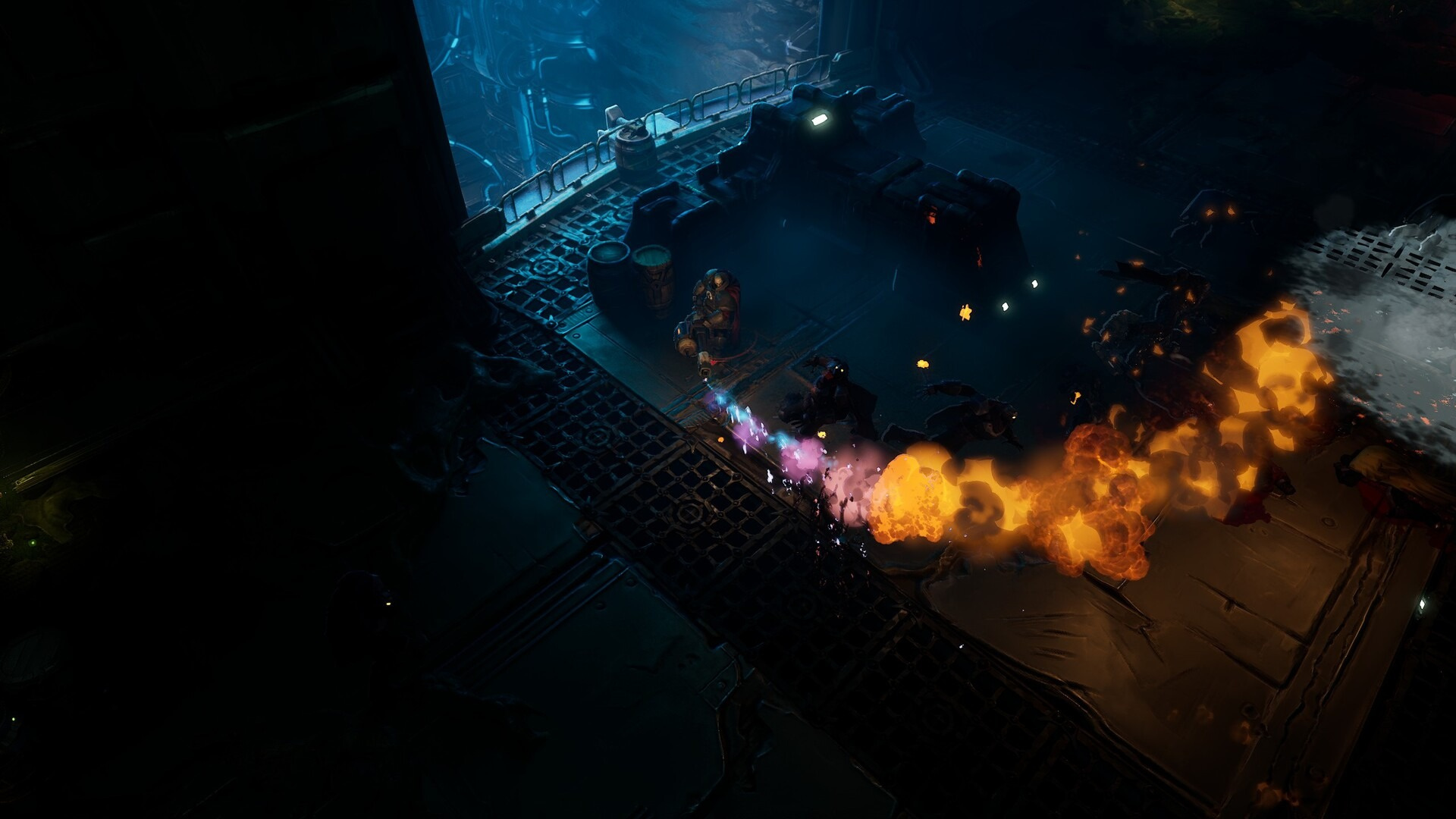
Combat should be where an isometric shooter wins me back, and this is where my disappointment is sharpest. The idea is sound on paper: ammunition is scarce, resources are limited, and the game wants me to approach each situation carefully, use the environment, and decide when it is worth spending bullets. Scarcity can create brilliant tension, but only if the act of fighting is satisfying when I do commit to it. In my time with the playtest, the shooting itself felt weak. Encounters lacked impact, enemies did not make me want to master their patterns, and the combination of sluggish movement with limited resources made fights feel more like an obstacle course of chores than a test of skill. When a horror shooter makes me feel underpowered, that should be scary. Here it mostly felt tiring.
Airship Syndicate's own description says the station is full of violent criminals, executioner guards and bio-engineered creatures that escaped containment, and that I am supposed to observe creature behavior and exploit weaknesses to survive. That is a good design goal. The trouble is that observation only becomes interesting when the result of that observation is a clear and rewarding play. In this build, the feedback was not strong enough for me to feel that learning an enemy was paying off. I was mostly managing slow movement, conserving resources and pushing through fights that did not change in any meaningful way as I went on. A survival game can be hard. It should not feel flat.
The bugs make everything worse. Airship Syndicate warned playtest participants that they might run into bugs, and I understand that an early build will not be polished. I am still reviewing what I played, and in my session the game was buggy enough that it repeatedly damaged my patience. In a fast, generous game, a technical problem can be an annoyance that I shrug off. In a slow game built around scarce resources and long routes, every bug costs more. Any interruption to momentum or clarity in a game that already asks a lot of my time is exactly the wrong combination, and it pushed me from mild frustration into genuine fatigue. A playtest is the right place to find these problems, but they are a real part of my experience and they are a real part of this score.
The structure of DUST: Origins depends heavily on discovery. The store page says the game does not hold the player's hand, and that much of the path forward has to be found by exploring the station, talking to NPCs and reading logs in the central terminal system. You collect disks, hack security, access restricted files and unlock upgrades and key items that allow backtracking. In principle, I like this approach. Games that trust players to read the environment can be fantastic. In practice, discovery only works when the world is engaging enough to make me curious. When the movement is slow and the moment-to-moment play is dull, the absence of guidance does not feel like respect for my intelligence. It feels like the game is adding even more time between the parts that are supposed to be interesting.
The terminal and log systems are a good example. Reading station files, finding codes and piecing together what happened on Limbo-6 should be one of the most atmospheric parts of a sci-fi horror game. A well-written log can make an empty room feel haunted. In this build, those systems mostly felt like more administrative work on top of an already slow loop. I spent time going back and forth between reading, searching and walking without getting the sense that the station was opening up in exciting ways. The setup is there, but the payoff that should make me want to keep digging was missing for me.
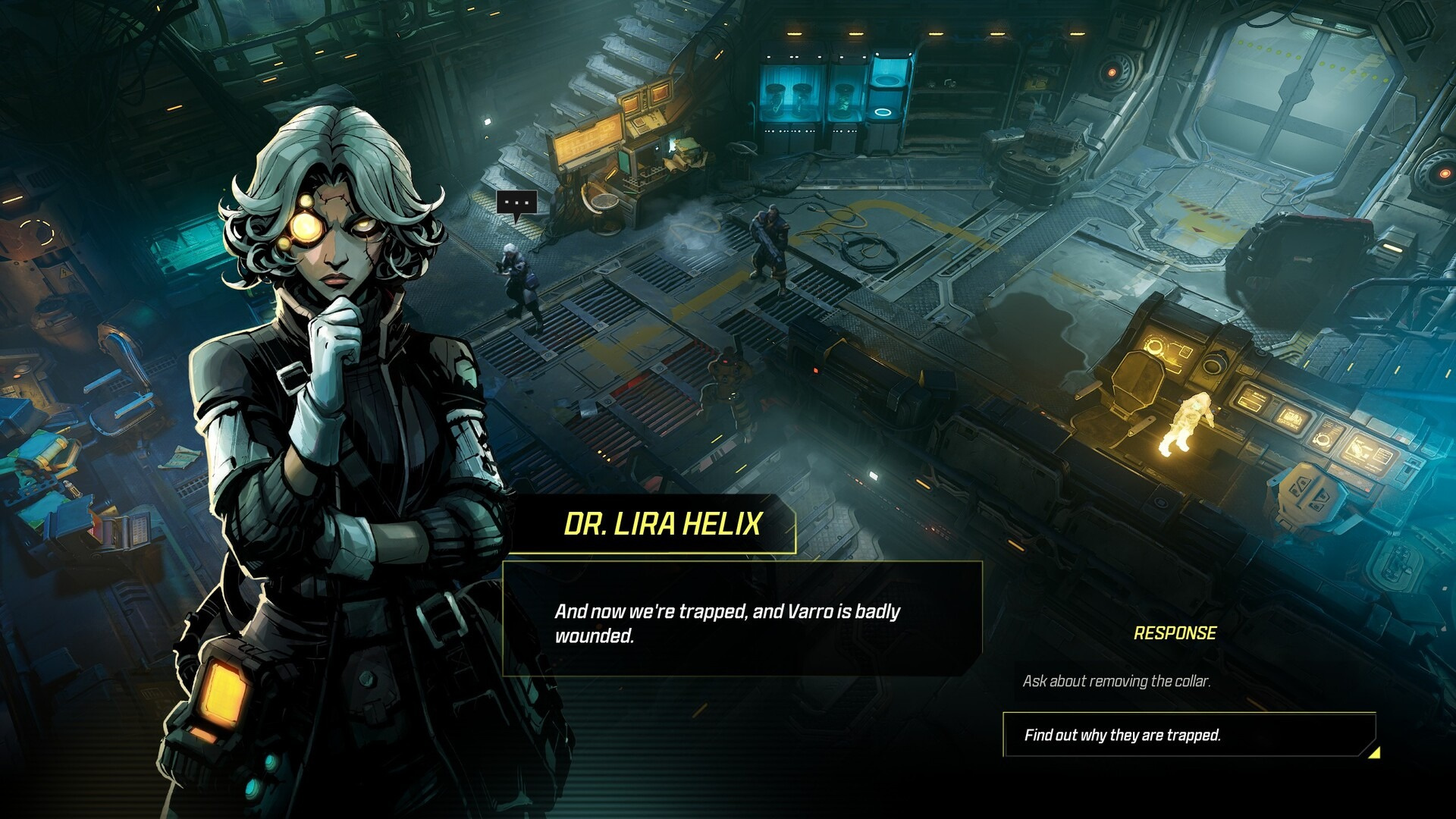
The survivors are supposed to give the station its human side. DUST: Origins promises characters with their own motivations who can help or hinder me depending on how I treat them, optional side missions that unlock items and areas, and the freedom to go it alone and leave everyone to their fate. Anyone can live and anyone can die, according to the pitch. The character portraits look great, with Madureira's style instantly recognizable, and the dialogue presentation is clean. My problem is that the conversations did not make the experience feel more alive in the time I played. Choice systems need context and stakes to work, and when the surrounding game is this sluggish, even an interesting decision gets buried under the effort it takes to reach it and see its consequences.
The premise itself deserved a stronger hook. Waking up as a prisoner on a decaying orbital platform, with guards executing inmates, systems failing and the orbit collapsing, is an excellent starting point for a horror story. It gives the game urgency built into its setting: the station is dying, and I should feel that the clock is running. In the playtest, I never felt that urgency translate into play. The setting says hurry, but the pace says wait. That contradiction drained the tension out of a scenario that should have kept me on edge from the first minute, and it made the station feel like a backdrop rather than a place that was actively trying to kill me.
This leads me to the biggest structural concern. DUST: Origins is designed around repetition at a higher level. The store page explains that it is meant to be played several times to see multiple endings, post-credits epilogues for different characters, and many Dead Ends, which are unique deaths that unlock extras in an endings collection. Completions carry over into New Game+, with new items and harder difficulties. I like replayable structures when the core loop is fun enough that I want to see it from another angle. Here, the core loop is exactly what wore me out. Asking me to play a slow, tedious, buggy game several times to see everything is not an incentive. It is a warning. If the first run already feels like a grind, the idea of a second and third run is not appealing at all.
Crafting and loadouts suffer from the same issue. I can collect materials and turn them into health items, ammunition, permanent stat upgrades and mods, and I can build a custom loadout of weapons, armor and mods within a limited inventory that expands with upgrades. These are standard survival-horror tools, and they can create great decisions: do I spend my scrap on healing now or save it for a stronger weapon later? Do I carry the extra ammo or leave room for a key item? The question is whether those decisions feel meaningful. In this build, they mostly felt like more menu management on top of combat that was not satisfying enough to justify the planning. When the payoff of a careful build is a fight that still feels weak, the planning itself loses its value.
I keep coming back to the art, because it is the one area where DUST: Origins clearly shows what Airship Syndicate is capable of. The key art is fantastic, the logo has personality, the character portraits have that thick, expressive comic-book style that made Darksiders and Battle Chasers so recognizable, and the environments have strong lighting with deep reds, cold blues and industrial detail. Screenshots of the station look rich and moody. The problem is that a game is not a gallery. The visual identity is the strongest thing about the build, and it still cannot compensate for how little the play itself excited me. Strong art can make a good game memorable. It cannot turn a weak one into a good one.
The horror suffers for the same reasons. Horror depends on rhythm: tension, release, surprise and relief. DUST: Origins has the visual language of horror, with gore, dim corridors, alien organisms and a station that is literally collapsing, but rhythm requires control over pacing, and pacing is what I think this build gets most wrong. When I am bored, I am not scared. When I am frustrated by a bug, I am not immersed. When I am tired of walking the same metal corridors, the horror elements become background decoration. The game wants me to feel hunted, and most of the time I just felt like I was waiting for it to get interesting.
It helps to compare this with what the genre does well. The best slow survival horror games treat time as a resource. A long route through a dangerous area matters because I am carrying a limited number of healing items, because I know a specific room is dangerous, or because I am deciding whether this trip is worth the risk. The walk itself becomes part of the tension. Classic Resident Evil, System Shock and their successors built their reputations on making players plan routes, count bullets and dread certain doors. DUST: Origins borrows several of those systems, including scarcity, inventory pressure, backtracking and logs, but in my time with it those systems never added up to that kind of dread. They added up to time spent. That is the difference between a game that is slow on purpose and one that simply feels slow.
The Dead End system is a clever idea on paper, and I can see why the studio is proud of it. Unique deaths that unlock extras turn failure into something collectible, and that can soften the frustration of dying in a harsh game. The problem is what death costs in a slow game. When getting back to where I was requires covering ground I have already covered, a creative death stops being a fun discovery and becomes another reason to repeat a long stretch I did not enjoy the first time. A system that rewards failure works best in a game where trying again is quick and exciting. In this build, the cost of trying again was the very slowness that already bothered me.
The game's refusal to guide the player also interacts badly with its pacing. I like games that let me find my own way, but that philosophy depends on the world being dense with clues and rewards. When the station feels large and the movement is sluggish, being unsure where to go next means more time wandering through areas that have already lost their novelty. A missed clue in a compact, tightly designed level costs me a minute. A missed clue in a big, slow level costs me much more, and that cost accumulates. Over a session of a little more than three hours, that accumulation is a big part of why I finished tired rather than curious.
If I could send a short list straight to the developers, it would be simple. Make moving around the station faster and more responsive. Give the shooting more impact so that spending scarce ammunition feels good and not just necessary. Tighten the spaces or fill them with more meaningful encounters, so that exploration produces surprises instead of distance. Make the information I find in terminals and conversations point more clearly toward the next interesting thing. Fix the bugs that break the flow. None of these suggestions would require abandoning what makes the project distinctive. They are about the fundamentals, and the fundamentals are what decide whether a game like this works.
My score reflects that. I am not giving DUST: Origins 2.5 because the concept is bad or because I dislike the studio's style. The concept is good and the style is excellent. The score is low because the experience of actually playing the build was slow, boring, tedious, buggy and exhausting, and because the structure around that experience asks me to repeat it. The art and the premise keep it from falling lower. They are not enough to lift it.
I also want to be fair about what a playtest is. Airship Syndicate is collecting feedback, and the studio's own recap of this playtest says survey respondents noticed improvements to combat, the interface and other areas compared with earlier tests. My experience with the build was very different, but the studio is clearly listening, and that is a good sign for the future of the project, and I would genuinely like to see a final version that makes the most of this setting and this art. But I can only judge what I played, and the version I played did not get the basics right. Movement, pacing, combat feel and technical stability are the pillars of a game like this. If those pillars are weak, everything built on top of them, from crafting and dialogue to multiple endings and New Game+, inherits that weakness.
To put my frustration in perspective: none of the individual pieces of DUST: Origins is a bad idea. Scarce resources are a staple of great survival horror. Isometric shooting can be fantastic. Story choices with consequences, terminal logs, side missions and multiple endings have made many games in the genre more memorable. The art team is excellent. What goes wrong is how those pieces combine in the playtest. Slow movement makes exploration tedious. Tedious exploration makes discovery a chore. Weak combat makes resource management feel pointless. Bugs turn all of it into fatigue. The result is a game that kept asking for my patience and almost never gave anything back.
Who might still get something out of it? Players who are already devoted to Joe Madureira's art and want to follow Airship Syndicate's projects closely might find value in watching DUST: Origins evolve, especially if they enjoy giving structured feedback in playtests. Fans of very slow, methodical survival games with lots of backtracking might be more forgiving than I am with the pacing. Even for those players, I would recommend waiting to see what the final version looks like rather than treating this build as a preview of a guaranteed good game. What I played does not justify that confidence.
Final thoughts
DUST: Origins has a great setup, a talented studio and art that immediately stands out, but the playtest I played is slow, boring, tedious, buggy, tiring and weak. The pacing drags, the combat lacks impact, discovery turns into busywork, and the bugs make every problem heavier in a game that already asks for a lot of patience. Its replay structure only reminds me that I would have to go through the same loop again. I hope Airship Syndicate uses this feedback to rebuild the fundamentals, because the potential is visible. Right now, I cannot recommend it. My final score is 2.5/10.
Final score: 2.5/10.
Reviewed on PC (Windows/Steam) during the DUST: Origins playtest in November 2026, with about 3.3 hours played. This review covers a pre-release playtest build; the full game does not have a release date yet. No review copy was provided.
 Sonic Origins Plus Review
 Sonic Origins Review
 Onimusha: Way of the Sword Review