Cloudbreaker has one clever hook, but the game around it feels like another survivors-like I have already played.
Cloudbreaker is a roguelite in the bullet heaven style made popular by Vampire Survivors: you pilot an airship through a sky-world, enemies swarm toward you in huge numbers, your weapons fire largely on their own, and the goal is to grow strong enough to survive while the screen fills with chaos. Ballast Games sums it up as bullet heaven meets inventory management, and that second half is the part that is supposed to make it stand out. Defeating enemies earns a resource called Bloil, which your ship converts into Engine Parts, and those parts have to be placed in an Engine Grid that works like an inventory puzzle. Where you put each part matters, because parts interact with the grid and with each other to create synergies. It is a good idea. My problem is that once the novelty of that grid wears off, Cloudbreaker settles into a very familiar rhythm, and nothing else in the game pushed me to keep going.
I will give the Engine Grid its due first. Bullet heaven games usually reduce your choices to picking one upgrade out of three every time you level up. Cloudbreaker asks for more thought. Each Engine Part has a shape and an effect, some parts boost the ones next to them, and different ships have different grid layouts, so the same parts can lead to a different build depending on the vessel. The studio's own pitch is that placement, not luck, decides the run, and I understand why that appeals to players who like to plan. In the first runs, figuring out how parts connect is the most interesting thing the game offers. It is the one element I can point to as genuinely its own.
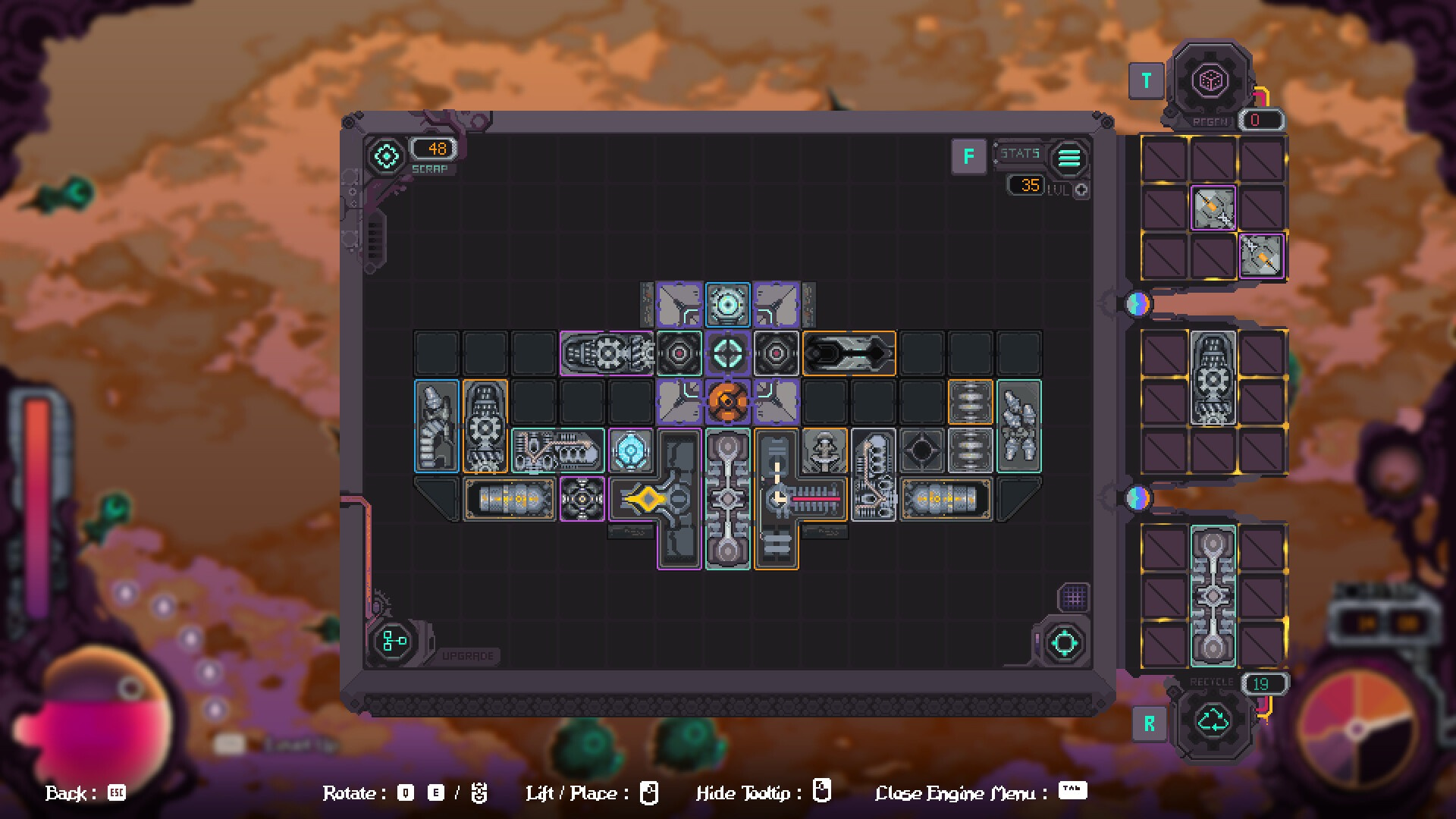
The trouble is that the grid sits on top of a structure that feels generic. You dive through layers of clouds, fight hordes of creatures called Biotes, collect resources and relics on sky islands, beat a boss to break through to the next layer and repeat. Between runs, you complete missions to unlock new parts, ships and relics, power up ship upgrade trees and try again. This is the standard progression of the genre almost step by step. When the core activity of moving, surviving and watching numbers grow feels the same as in many other bullet heaven games, a smarter upgrade screen is not enough to make the whole experience feel new to me.
Combat is exactly what you would expect. The screen fills with enemies, your weapons shred them, and your job is to position the ship, avoid damage and keep the build growing. Weapons have their own upgrade trees that change how they work, relics can alter combat and open up strategies, and there are bosses, mini-bosses and enemies designed to force you to adapt. There is also an Overcharge healing mechanic that rewards aggressive play, since you need to keep fighting to stay alive. These are sensible systems, and none of them is badly made. They are simply the kind of variations I have seen many times in this genre, and in the moment-to-moment action Cloudbreaker rarely felt different from the dozens of survivors-likes that came before it.
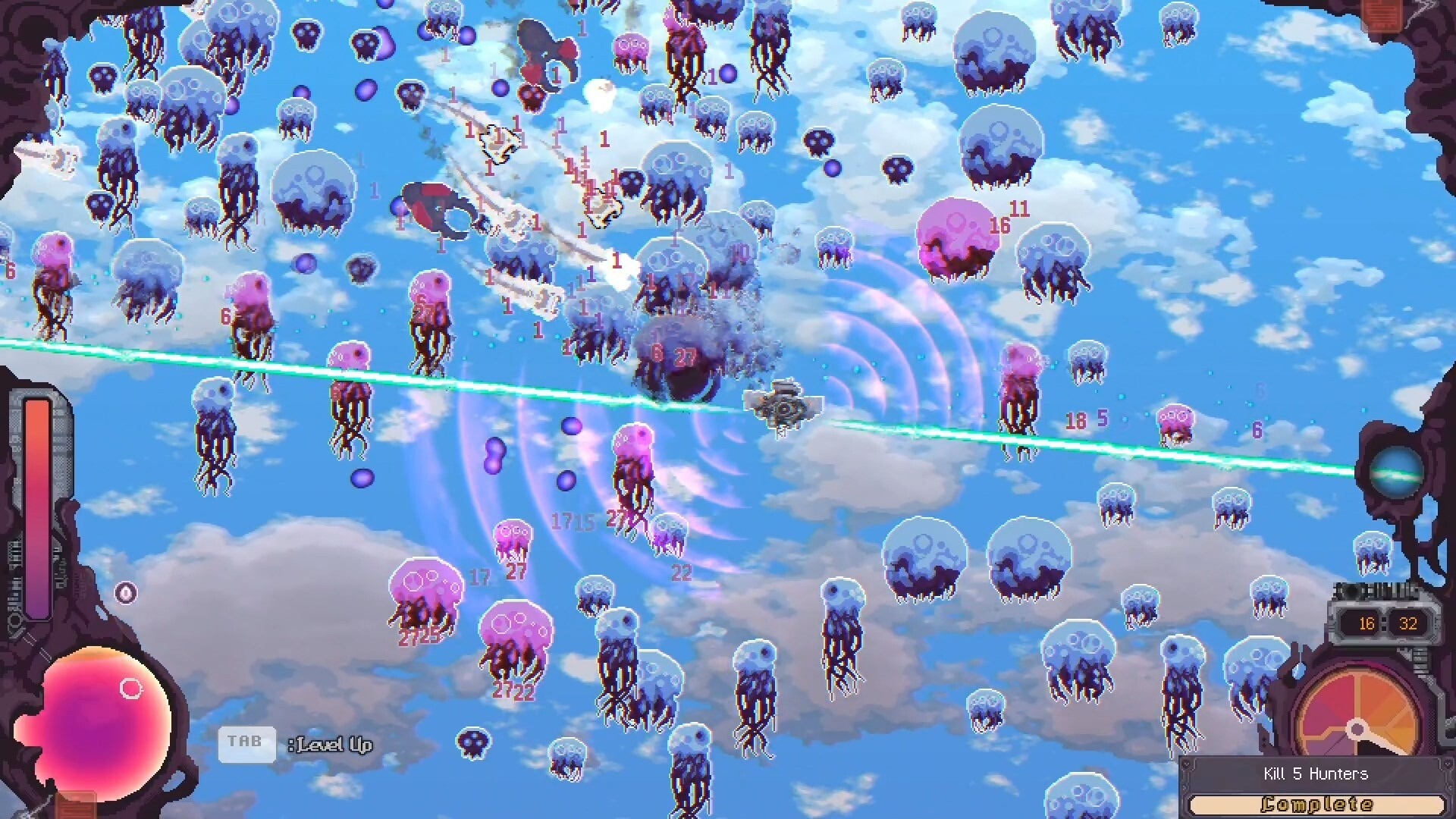
The setting helps a little. Diving through a sky-world full of ruins, floating islands and biotech experiments left behind by past civilizations is a nicer backdrop than the dark fields of many genre rivals. The pixel art is clean, the creatures have a strange, organic look, and the official key art, with its airship facing tentacles and floating jellyfish, has real personality. Even so, during runs the screen quickly becomes the same mass of enemies, projectiles and effects that defines every bullet heaven game. The sky theme is pleasant, but it does not change how the game plays.
The split between action and planning also creates a rhythm problem for me. Bullet heaven games are at their best when they flow: you make quick decisions, return to the action and feel your power snowball. Cloudbreaker interrupts that flow to send you back to the grid to place parts. If you enjoy puzzle-like inventory management, that pause will feel like the best part of the game. I found that it slowed the momentum without giving me enough in return, because the action I was returning to did not change much regardless of the build.
Progression is built to keep you coming back. Each ship has its own grid layout, abilities and upgrade tree, so unlocking a new vessel means a new puzzle to solve. Missions unlock parts and relics over time, and there is an Endless Mode for testing a build to its limit, plus Difficulty Modifiers that let you replay stages with extra challenge for bigger rewards. That is a healthy amount of content for a game at this price. The question is whether the loop is engaging enough to make you want all of it, and for me the answer was no. Unlocking more parts and ships gave me more variations of the same activity, not a reason to feel excited about the next run.
On the technical side, the game supports keyboard and mouse as well as controllers, and Ballast Games has released updates focused on performance, higher resolutions and Steam Deck optimization, with the game now marked as Steam Deck Verified. The modest system requirements also mean it should run on a wide range of PCs. Nothing here stood out to me as a problem, which is good, but polish alone does not lift the experience.
I can see why the inventory grid would resonate with people who wanted more strategy from the genre. If you love survivors-likes and you are specifically looking for one that rewards careful build planning more than luck, it may click for you in a way it did not for me. My verdict reflects my own experience: I recognized almost everything outside the grid, and the grid alone was not enough to hold my interest.
That is why I see Cloudbreaker as a game for a sale. At R$ 47.99 on Steam in Brazil, it asks for the price of a complete experience in a genre packed with cheaper and more distinctive options. At a discount, its one strong idea becomes a reasonable reason to give it a try, especially if you have exhausted the games you already like. At full price, I would rather recommend something that feels more original from start to finish.
Final thoughts
Cloudbreaker has a smart hook in its Engine Grid, a pleasant sky setting, solid technical work and plenty of ships, parts and modes to unlock. Outside the grid, though, it is a generic bullet heaven roguelite that rarely does anything new, and the pauses for inventory management slow down a loop that already felt too familiar to me. It is not a bad game, but it did not win me over. Wait for a sale. My final score is 4.5/10.
Final score: 4.5/10.
Reviewed on PC (Steam). A review key was provided by Ballast Games.
 Onimusha: Way of the Sword Review
 DUST: Origins Playtest Review
 Grand Theft Auto VI Review