
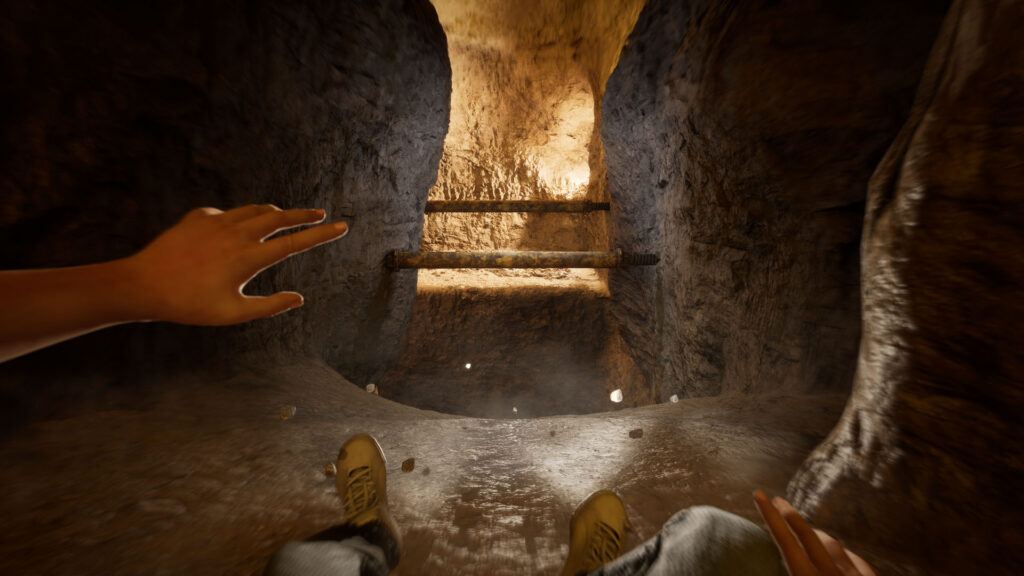
Terrible Lizards, available now on XBOX Series X|S and Game Pass, is a first-person platforming game about escaping runaway dinosaur animatronics in an abandoned roadside attraction. That perspective was something we landed on pretty deliberately, through a process of both considering this particular game’s needs, as well as reviewing what we’ve loved about movement in other games.
When I think about the platforming games I’ve always enjoyed most, a lot of it comes down to rhythm. I like being able to move quickly, react to what’s coming, and string things together without constantly stopping to line everything up.
You can see that reactive flow really clearly in older 2D platformers like Donkey Kong Country or the early Mario games. With a limited screen in front of you, you don’t always have much time to plan. You’re reacting, trusting the mechanics, and finding a rhythm as you move through the level. That’s what I wanted to bring into Terrible Lizards, and the first-person perspective is a big part of bringing that satisfying, rhythmic, reactive gameplay to a 3D platformer.
Games like Mirror’s Edge and Dying Light are the obvious first-person platforming reference points, but we actually wanted Terrible Lizards to feel a little different moment to moment. We were chasing the tighter, more immediate game feel you get from games like Titanfall, Call of Duty, and Overwatch, where simply moving, jumping, and changing direction feels responsive and satisfying. You do see that kind of feel in first-person platforming games like Neon White, and that was closer to the balance we wanted: strong platforming mechanics built on top of controls that already feel good before you even start chaining moves together.
The controls needed to feel tight and immediate, but we also ended up giving the player a little bit of floatiness in the air. That mostly came from our aerial control system. Once you jump, you have the ability to adjust your trajectory before you land, and that became one of the most important pieces of the movement system.
For someone who isn’t especially confident with first-person platforming, it gives you room to correct yourself. If you jump too far, you can pull back. If you drift left or right, you can make a small adjustment. You have a little extra time to understand where you’re going and make the landing. At the same time, someone who gets really comfortable with the system can exploit that same freedom. They can make harder jumps, move through sections more efficiently, find faster routes, and occasionally bypass parts of a platforming sequence entirely.
That gave us something we were really happy with: a low skill floor, but a high skill ceiling. You don’t have to be amazing at platformers to play the game, but there’s a noticeably different way of moving through it once everything starts clicking. You can absolutely slow down, explore, look for collectibles, and work your way through the environments methodically. But once you understand the movement and start chaining together jumps, slides, wall runs, clambers, ledges, and swings without really thinking about each individual input, there’s a flow state to it that I find really satisfying.
We also made a very deliberate decision not to give the player weapons or other means to fight back. Your movement is really your main way of dealing with danger. When one of the creatures comes after you, the answer isn’t to turn around and shoot it. You have to move, and that made the monsters a natural way to test everything the player has been learning.
Sometimes that’s a direct chase. Sometimes a creature causes the environment around you to start collapsing and you have to survive. Other times you’re dropped into a more open arena where the monster is loose in the space with you and you have to complete objectives or figure out how to escape. Those moments let us use the same core movement mechanics in different ways without turning every encounter into the same kind of chase.