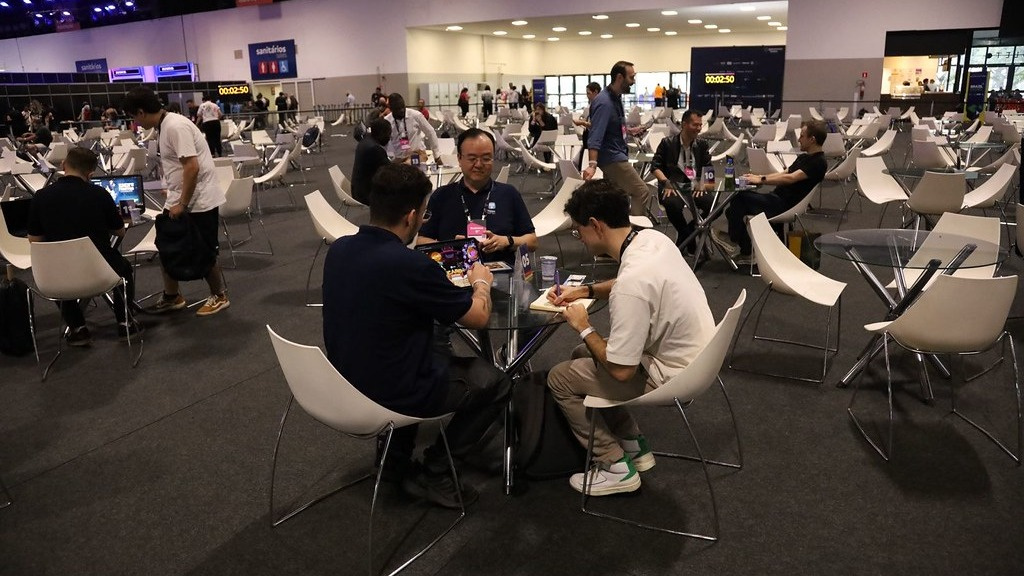
Brazil's game development scene now counts roughly 1,680 active operations, including formal studios, collectives and independent developers, with combined revenue estimated at R$495 million. That figure leaves out the country's largest high-revenue companies. The numbers come from a preview of the 2026 Brazilian Games Industry Survey, carried out by Abragames, the Brazilian Association of Digital Game Developers, and produced by research firm Go Gamers. The results were presented on November 26 at ESPM in São Paulo.
The previous edition, released in 2024, mapped 1,042 active studios. This year's count is about 61% higher, although the scope also grew to include collectives and solo developers, so the two editions are not a direct like-for-like comparison.
Most of the sector is small. 66% of Brazilian studios work with teams of five people or fewer, and almost a third of companies and collectives started operating in 2024 or later. Activity is high anyway: 95% have projects in progress, and 81% created their own intellectual property in the last 12 months. Among studios that make their own games, 67% have already released at least one title commercially.
Money is the weak spot. 53% of studios reported revenue of up to R$81,000, or no revenue at all, in 2025.
"The results show that Brazil has an increasingly broad and diverse games industry, capable of developing competitive intellectual property," said Abragames president Rodrigo Terra. He added that the main challenges are making studios financially sustainable and helping more of them grow into new markets.
Developers rate their own technical skills highly: 80% of teams that handle programming in-house call their competence high or very high, and 72% say the same about game design. Steam is the main publishing channel for original games, cited by 59% of studios.
44% of studios already work abroad in some form, and another 41% plan to. Among studios founded in 2022 or earlier, international presence reaches 63%. The numbers suggest it matters: 25% of studios with foreign revenue closed 2025 in the black, against just 7% of those that sell only in Brazil.
Experience helps too. 28% of studios founded by 2022 ended 2025 with a positive result, double the rate of newer ones, and more than 80% of that older group already generates revenue.
Many studios fund original projects with outside work. 38% of IP-owning studios rely mainly on services and co-development for revenue, and 42% of service-focused studios ended 2025 with a positive result. Asked about priorities for the next two years, 74% named financing, followed by marketing (51%) and access to publishers (44%).
Over the past 24 months, 57% of developers attended industry events, 43% joined mentoring programs and 40% took part in business rounds. 67% sought or received money through public calls and funding programs.
Patrícia Sato, executive manager of the Brazil Games export program, said the data will help shape internationalization and sustainability strategies for each type of studio. Raquel Gontijo, Abragames' director of institutional and government relations, argued that reliable data is the starting point for public policy, since no market attracts investment in an unfavorable environment.
The survey looks at the industry across six areas and cross-references studio data with player behavior from the Pesquisa Game Brasil 2026 study. From that, it points to four fronts: business, marketing and publishing skills for studios; better preparation for publisher negotiations; financing suited to each stage of production and launch; and stronger international presence through trade missions, fairs, localization and commercial representation.
The full 2026 survey has not been released yet. This preview already shows an industry growing fast in numbers, while most studios are still working out how to make a living from it.