
The elastic partnership is a great hook in an adventure that does not always know how to use it
The elastic link is the reason Knuckles' Chaotix is interesting, and it is also the reason the game can be frustrating. Two characters are physically connected, so running and jumping become actions that have to account for the other end of the bond. I like the idea enormously. It gives a familiar-looking platformer an immediate identity and turns a partner into something more active than a character following behind. What I enjoy less is the adventure built around it. Some spaces let the link create a satisfying burst of movement; others make managing the partner feel more noticeable than the stage itself. The result is a game I find inventive and mixed rather than especially strong. I am glad Chaotix tries something this distinctive, but the quality of a central idea is only part of the experience. The places that use the idea need to be consistently enjoyable too, and that is where my enthusiasm becomes qualified.
The bond behaves like an elastic connection rather than a simple rule that the characters must stand close together. One partner can hold position while the other stretches away, creating momentum when that tension is released. Throwing a partner also changes how a higher platform or distant space can be reached. I enjoy those actions because they make the physical relationship between the characters part of understanding the level. The movement has a quality that an ordinary run and jump would not provide. At the same time, arranging the connection can interrupt the pleasure of simply going somewhere. I want the setup to feel like part of an enjoyable movement rather than a small piece of administration before the movement can happen. Chaotix moves between those two feelings more often than I would like. The mechanic is genuinely useful and expressive, but I do not find every requirement to organize the pair equally satisfying.
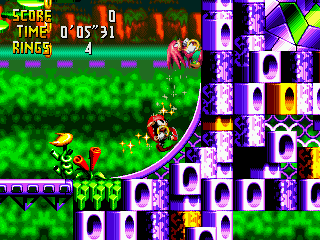
The characters give that relationship different possibilities. Knuckles, Mighty, Espio, Vector and Charmy have distinct abilities and movement characteristics, while the additional partner choices bring their own complications. I like that the cast has a practical role instead of functioning only as a collection of alternate sprites. A character who climbs or flies changes what the other end of the bond can contribute to the route. The game therefore asks for attention to the pair rather than only the lead character. That is an interesting way to broaden the controls. My reservation is that having more combinations does not automatically make the current stage more enjoyable. A useful pairing can make the mechanic feel inventive; a less comfortable relationship can make the movement feel harder to organize. I appreciate the range of possibilities while wishing that the adventure made those possibilities feel more consistently natural to use.
The attraction structure gives the stages a distinctive setting. The game returns to its different areas through several levels, with changes in time of day affecting parts of the environment and its arrangements. I like that the same place can have a different mood and practical condition rather than being represented only once. That gives the visual identity room to develop. The repetition is also one of my main reservations. Revisiting a theme can be enjoyable when the new arrangement gives the central mechanic another interesting task. It is less appealing when the return feels more like another pass through a familiar setting than a meaningful development of it. For me, Chaotix does not keep that balance consistent enough. There are good places to experiment with the elastic movement, but the overall journey can feel stretched around the idea instead of giving each return an equally strong reason to exist.
Recalling a separated partner at the cost of rings is a useful acknowledgement of how awkward the pair can become to manage. It gives the player a way to reunite the characters instead of always demanding that the current arrangement be solved through movement alone. I appreciate that practical option, though needing to think about it also highlights what I find least appealing about the system. The partner is supposed to make the movement more interesting. When the relationship becomes a problem to clear away before continuing, the novelty is much less enjoyable. The ring and failure structure differs from a conventional classic Sonic stock of lives as well, giving the larger adventure another distinctive rule set. Those differences make sense within the experiment, but they do not change my basic reaction. I enjoy the link when it creates an opportunity, and I become much less enthusiastic when it feels like a condition that has to be managed before the opportunity can happen.

The presentation gives the game a strong personality. I love the bright colors, expressive cast and distinctive musical atmosphere. The 32X adventure has a confident visual identity, making the stages pleasant to look at even when I am less interested in the current route. The forward-looking special stages give the collectible hunt another memorable activity too, with Chaos Rings taking the place of the usual Emeralds. I like that the package has several recognizable ideas rather than relying entirely on one unusual control feature. My reservation is that the visual and musical charm can be stronger than the layout carrying it. A colorful place and a pleasant soundtrack make me want to enjoy the next section, but they cannot make an awkward arrangement of the pair more satisfying on their own. The game looks and sounds like an appealing experiment; playing it reveals a much more uneven relationship between that personality and the actual movement.
I give Chaotix a six and a half because its central experiment is worthwhile without producing a consistently strong adventure. The elastic connection has real expressive possibilities, and the characters, settings and music make the package easy to remember. I enjoy how different the movement can feel when the level and the partnership work together. The repeated settings and the interruptions caused by managing the pair keep that enjoyment from becoming dependable. I would recommend it with clear qualifications to someone interested in unusual platforming systems. I would be much less confident suggesting it simply as another smooth classic Sonic-style journey. For me, it is a game with a very good hook and a less convincing way of carrying that hook across its full structure. The invention is worth appreciating, but the regular experience of using it remains too uneven for a stronger recommendation.
Final thoughts
I like the elastic partnership and how it gives the characters a genuinely different relationship with the levels. The cast, colors and music make Chaotix especially memorable. Managing the pair can interrupt the fun, and the repeated settings do not always develop the central idea convincingly. It is a worthwhile experiment with inconsistent enjoyment, earning a qualified 6.5/10 from me.
Final score: 6.5/10.
Reviewed on Sega 32X. No review copy was provided.
 Sonic the Hedgehog 3 & Knuckles Review
 Sonic & Knuckles Review
 Knuckles in Sonic the Hedgehog 2 Review