
Armor and arena walls give the fights personality, but the combat leaves me fairly cold
Fighting Vipers has two ideas that make its fights immediately recognizable: armor that can be broken away and walls that make the arena part of the action. I like how clearly those systems give the game a personality of its own. A character's protection is visible, the space has a boundary and a strong attack can have a dramatic relationship with both. My reaction to the combat underneath that presentation is much more neutral. I understand the attraction of its direct punch, kick and guard foundation, but I do not find the regular exchange especially compelling. The result is a fighter whose individual features are more interesting to me than the feeling of playing another match. A five reflects that mixed reaction. There is enough character and purpose in the design to appreciate, while too little satisfaction in the ordinary decisions and attacks to make the whole package something I would recommend enthusiastically.
The basic action language gives the player a straightforward way to understand the fight. Guard, punch and kick provide a small foundation from which the combinations develop, so the game is not trying to communicate its identity through a large number of unrelated buttons. I appreciate that clarity. A useful attack can be understood in relation to distance, timing and what the opponent is doing. My reservation is about how enjoyable I find working through those relationships here. I am more interested in the next interaction with armor or a wall than in the regular exchanges that lead toward it. That is a meaningful problem for a fighting game, because the smaller decisions have to carry the match between its dramatic moments. The foundation is coherent, and I can recognize why it invites learning. I simply do not find the movement from one ordinary attack or defensive choice to the next satisfying enough to become absorbed in improving it.
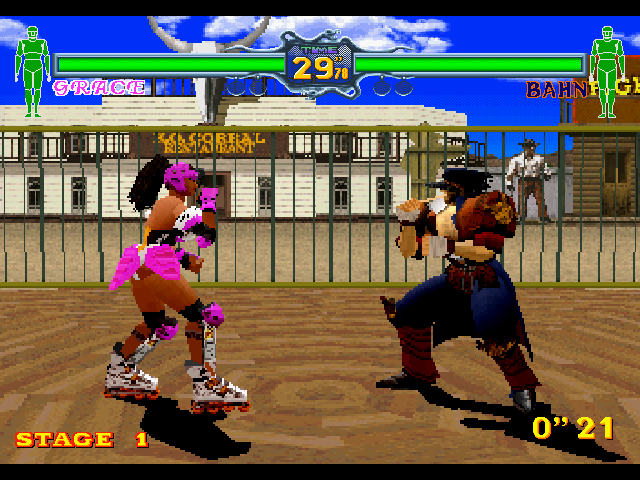
The armor gives those exchanges a clear larger consequence. Damaging and breaking an opponent's protection makes later hits more dangerous, so the state of the fighter changes as the round develops. I like that the mechanic has both a visible and practical role. It is easy to see why protecting a character and putting pressure on the other side matter beyond the damage from a single attack. The human-shaped indicator helps make that state part of the information around the match. A fighter who has lost protection is in a different practical position from one whose armor remains intact. I like how clearly the appearance and the incoming damage can communicate that shift, even if I do not enjoy every exchange leading to it. For me, this is one of the game's better ideas because it gives the fight a sense of alteration instead of leaving every moment visually unchanged until someone falls. My enthusiasm remains limited by how much pleasure I get from the actions used to reach that change. Breaking armor is a strong attraction, but the interaction around it does not make the process consistently enjoyable for me. It supplies a worthwhile goal inside combat I still find only moderately appealing.
The walls are the other obvious source of identity. They keep the fighters within a defined space and allow attacks to interact with the edge rather than treating it only as a line that ends the round. I enjoy that an arena can matter through something visible and understandable. Positioning near a wall gives the same exchange a different context from standing in the center. The dramatic possibility of sending an opponent through the wall at the end of a round also gives a finish a strong visual punctuation. Those moments fit the game's louder personality well. My reservation is that spectacle is more immediately appealing than the regular pressure needed to create it. I want the whole exchange to feel worthwhile, not only the part where the environment produces a memorable response. The arena system makes the fights more distinctive without changing my fairly neutral reaction to much of the actual combat.
The cast supports that confident visual identity. The characters have a stronger sense of exaggerated style than a completely restrained fighting presentation would provide, and their armor makes the central mechanic easy to recognize. I like that the package does not look interchangeable with every other early 3D fighter. On Saturn, the recognizable forms and direct action language help the main idea remain clear. The Saturn controls retain the guard, punch and kick foundation while additional buttons provide access to combinations. I like that the basic approach remains understandable without removing the need to judge what the opponent is doing. The practical options make the inputs approachable, even though the feel of the matches remains my main reservation. My reaction is to the way the fights feel as an overall activity: visually characterful, mechanically understandable and only moderately enjoyable. The presentation gives me a reason to be interested in another character or another dramatic exchange. It does less to make the repeated process of attacking, guarding and managing the space especially absorbing. That gap between a strong identity and a more ordinary amount of enjoyment defines the experience for me.

I do not come away from Fighting Vipers thinking its distinctive systems are empty gimmicks. Armor affects the state of the fight, and the walls affect how the arena can be used. Those are clear, purposeful ideas. The low level of enthusiasm comes from how little the underlying exchange makes me want to stay with them. I can appreciate a dramatic armor break or a strong finish without finding enough pleasure in the repeated decisions surrounding it. A five reflects a fighter that I find competent and memorable in parts, but unexciting as a complete activity. I would explain its two central mechanics to someone curious about it rather than treating recognition of those mechanics as a recommendation by itself. For my tastes, the game is more successful at establishing a personality than making that personality consistently enjoyable to play. The interesting parts are real; the attraction of the whole remains limited.
Final thoughts
I like the visible consequence of armor breaking and the way arena walls contribute to the action. They give Fighting Vipers a clear identity and some memorable moments. The regular combat exchange does not make those moments enjoyable enough to pursue consistently for me. It is a purposeful fighter with a fairly ordinary amount of overall fun, settling at 5/10.
Final score: 5/10.
Reviewed on Sega Saturn. No review copy was provided.
 Marvel Tōkon: Fighting Souls Review
 Avatar Legends The Fighting Game Review
 Onimusha: Way of the Sword Review